Can We Stop Killing Each Other?
Our new Universal Ticket allows access to our entire gallery. This ticket operates on a ‘Pay If and What You Can’ basis. Upon arrival, please go to gallery reception where our universal ticket is available. No pre-booking necessary. If you would like to make a Group Booking or have additional access needs, please contact us on scva@uea.ac.uk or 01603 593199
Please note that this season of exhibitions and events has now passed. It took place from 2 August 2025 to 17 May 2026.
The autumn season wrestles with one of the darkest and deadliest aspects of humanity.
A series of exhibitions explores the fundamental questions of why humans are led to kill and the culture that wrestles with this notion such as in art, film, TV and theatre.
Reflecting on the real material culture linked to particular case studies from the past and present, such as the Holocaust and the Genocide against the Tutsi in Rwanda of 1994, the season will be a challenging but eye-opening consideration of some of the most horrifying events in human history.
A series of new paintings by Ethiopian artist Tesfaye Urgessa (b.1983) have been unveiled, reflecting on the refugee crisis and created in dialogue with the Sainsbury Centre collection. Influenced by neo-expressionism and the London school, Urgessa’s figurative paintings explore the politics of race and identity.
This season has been developed in consultation with partners to provide a sensitive presentation of artworks to foster empathy and understanding through compassionate dialogue.
Tiaki Ora ∞ Protecting Life: Anton Forde
2 August 2025 – 19 April 2026
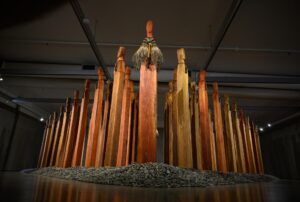
Anton Forde’s (b.1973), Invercargill, Aotearoa (New Zealand) monumental installation of 81 over-life-size figures, Papare Eighty.one (2024) with Shiree Reihana, is shown in the UK for the first time in a new site-specific configuration and incorporating one of the earliest surviving wooden Māori figures in Europe, held in the Sainsbury Centre’s collection.
Forde’s work connects with the peaceful actions of the Māori community at Parihaka, New Zealand in November 1881, in the face of a British colonial invasion, and the many examples of similar world-wide powerful peaceful responses that have been inspired by Parihaka. It is a call for kotahitanga: unity, togetherness and solidarity. It shows that collective action can safeguard the future of our communities for generations to come, without need for killing – both physically and culturally.
Eyewitness
20 September 2025 – 15 February 2026
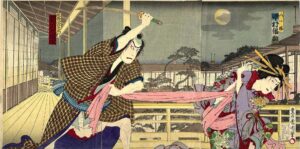
Why are people across the world so fascinated by the dramatisation of killing? From Shakespearean tragedy to Hitchcock’s Psycho, the spectacle of violence is central to performance traditions around the world. Through an exploration of historical and contemporary works by international artists, grappling with the horrors of homicide, Eyewitness considers how violent stage and screen narratives can invite questions about our own morality, cultural codes and religious beliefs.
Curated by Vanessa Tothill, Curator of Transhistorical Narratives at the Sainsbury Centre
Roots of Resilience: Tesfaye Urgessa
20 September 2025 – 15 February 2026
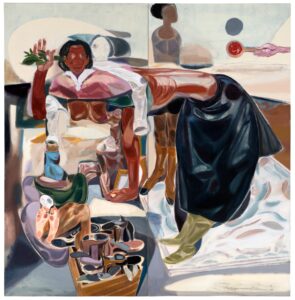
Shaped by themes of geographical displacement and migration, internationally acclaimed Ethiopian artist Tesfaye Urgessa creates powerfully visceral paintings that interrogate the politics of war, race and identity.
Following a residency with the Sainsbury Centre, Urgessa has unveiled a series of new paintings reflecting on the refugee crisis, which have been created in dialogue with the museum’s collection. Works will investigate layered narratives of war, migration, and survival, reflecting on resilience.
Curated by John Kenneth Paranada, Curator of Art and Climate Change at the Sainsbury Centre.
Supported by Cheng-Lan Foundation and Saatchi Yates.
The National Gallery Masterpiece Tour: Reflections on Peace
20 September 2025 – 11 January 2026
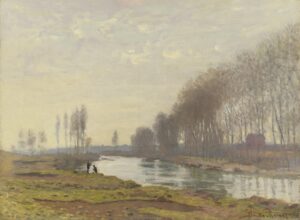
Claude Monet’s The Petit Bras of the Seine at Argenteuil (1872) is presented in a multi-sensory reflective space within the Sainsbury Centre, which encourages contemplation around the importance of sanctuary and a safe home.
Monet spent a year in voluntary exile in England and the Netherlands during the Franco-Prussian War, returning to France in 1871 where he settled in Argenteuil near the river Seine. Here, having found a sense of stability and home, his artwork flourished as he created paintings inspired by his surroundings, such as The Petit Bras of the Seine at Argenteuil. The presentation of this evocative work will be used to develop and research trauma-informed cafes as part of the Sainsbury Centre’s Compassionate Museum programme.
A new fragrance will be created for the exhibition by IFF, a leading global fragrance house, which will evoke a sense of calm and serenity using its proprietary Science of Wellness tool.
The National Gallery Masterpiece Tour is organised by the Sainsbury Centre and the National Gallery, London. Specialist insurer, Hiscox, is proud to support The National Gallery Masterpiece tour.



Seeds of Hate and Hope
28 November 2025 – 17 May 2026
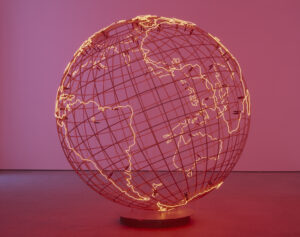
Seeds of Hate and Hope highlights personal artistic responses to global mass atrocities, such as genocides, ethnic cleansing, war crimes and crimes against humanity. Throughout the 20th and 21st centuries artists have witnessed, experienced, and responded to atrocity crimes and conflicts with powerful and compelling works. Drawing courage and inspiration from personal experience as well as shared histories, they have reacted to these events for many reasons including but not limited to bearing witness, expressing grief, and promoting healing.
With the aim of raising awareness about global conflicts and the role of art in confronting their legacy, the exhibition highlights artistic responses to such devastating events with creativity and courage. It features works by Mona Hatoum, William Kentridge, Zoran Mušič, Peter Oloya and Kimberly Fulton Orozco, Indrė Šerpytytė, and many more. Focussing mostly on abstract representations, Seeds of Hate and Hope challenges typical depictions of war and conflict often shown in the media.
Through its diverse body of work, Seeds of Hate and Hope explores how both individual and collective acts of resistance and resilience often take root in times of conflict. The exhibition emphasizes the vital role that respect for diversity plays in safeguarding society against the destructive forces of prejudice, hate speech, discrimination, and dehumanisation. Each artwork becomes a catalyst for healing—promoting tolerance, empathy, and understanding across cultures, religions, and identities.
Curated by Tafadzwa Makwabarara, Curator of Cultural Empowerment at the Sainsbury Centre and Jelena Sofronijevic, independent curator, writer and producer of the EMPIRE LINES podcast.
Exhibition research supported by the Jonathan Ruffer grant from the Art Fund.

Content warning
Please be aware, there are some depictions of violence in screening rooms within Gallery 2 as part of the Eyewitness exhibition. They are separate spaces, so please avoid them if you do not want to view the content. These separate spaces may not be suitable for children, containing film content rated aged 15, and flashing lights in enclosed spaces. In Gallery 2 you will also hear the sound of gunfire from an art installation.
There is another route to Roots of Resilience: Tesfaye Urgessa and The National Gallery Masterpiece Tour: Reflections on Peace that enables visitors to bypass the Eyewitness exhibition in Gallery 2.
The exhibition, Seeds of Hate and Hope includes drawings, paintings and sculpture representing ghostly, contorted, and skeletal human bodies, bound figures and an animation depicting violence including a hanging. The works and themes in this exhibition might be distressing for some. If you prefer not to view this exhibition, we have a range of art to see from our Living Area collection display, Sculpture Park, and further exhibitions as part of Can We Stop Killing Each Other? in our East End Gallery and Lower Galleries.
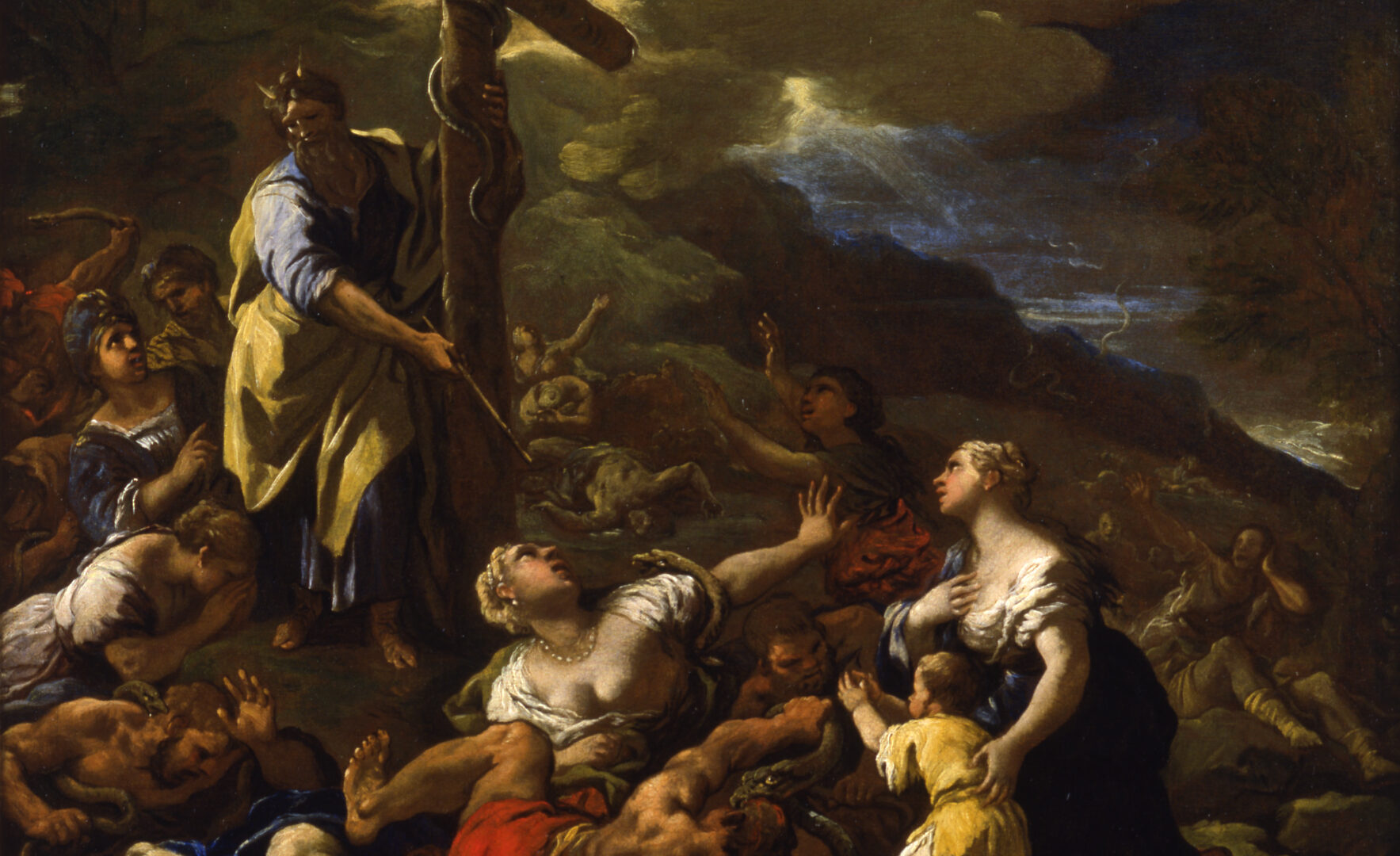
Images from top:
Luca Giordano, The Brazen Serpent, c1690, oil on canvas (CVCSC:0380.2.S) © Compton Verney, photography by Jamie Woodley.
Anton Forde, Papare Eighty.one, 2024, at Pātaka Art + Museum. Photo by Mark Tantrum.
Toyohara Kunichika, Ichikawa Sadanji I as Jirozaemon and Nakamura Fukusuke IV as Yatsuhashi in Kagotsurebe sato no eizame, 1888, colour woodblock print. Courtesy of Paul Griffith Collection.
Tesfaye Urgessa, First Flame, 2025
Claude Monet (1840- 1926), The Petit Bras of the Seine at Argenteuil, 1872, Oil on canvas © The National Gallery, London.
Mona Hatoum, Hot Spot, 2006. Stainless steel, neon tube. Courtesy of the David and Indrė Roberts Collection. © Mona Hatoum. All rights reserved, DACS 2025. Image courtesy of White Cube. Photo: Stephen White
Stay in the loop
– Jago Cooper, Sainsbury Centre director
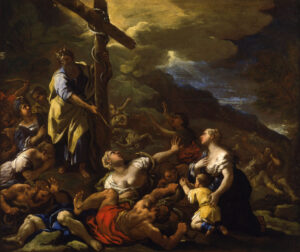
Luca Giordano, The Brazen Serpent, c1690, oil on canvas (CVCSC:0380.2.S)
© Compton Verney, photography by Jamie Woodley.