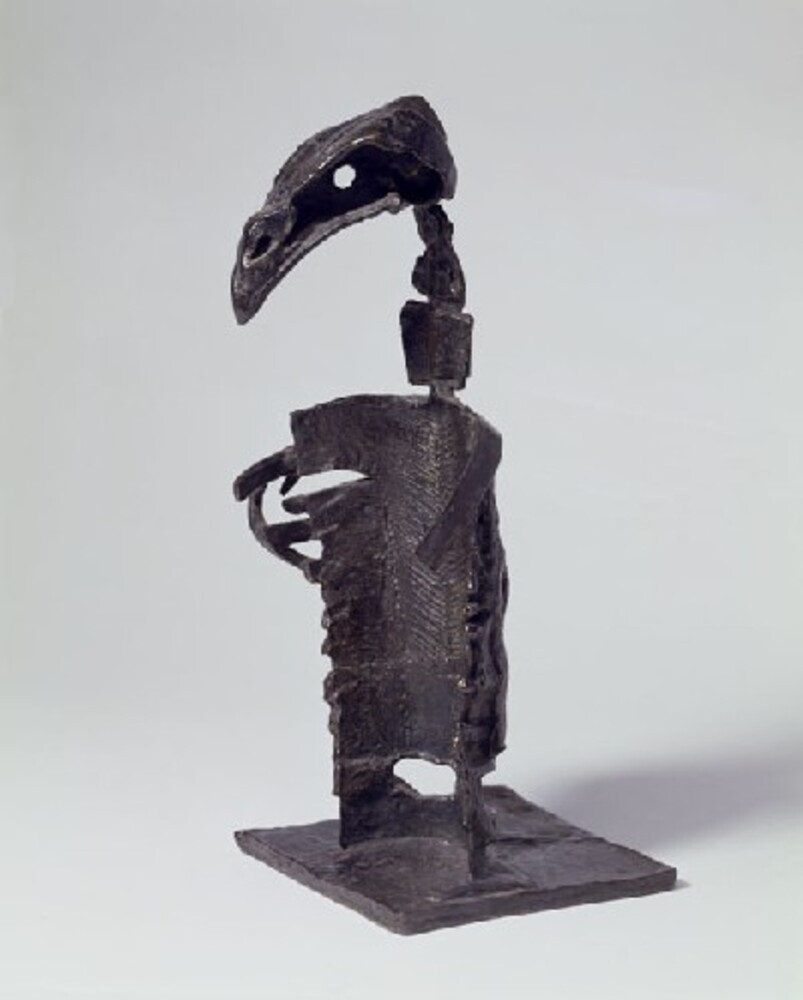
Man-Bird
Germaine Richier
Life Story
Germaine Richier is often associated with a group of artists working in France after the Second World War, such as Alberto Giacometti and Jean Dubuffet, that express existential angst largely through distorted figuration.[1] This may be justified since it is evident that Richier’s work shifted during this period. In the 1920s Richier had trained in Paris working under the sculptor Antoine Bourdelle, who had himself been Auguste Rodin’s assistant. Her own work during that period focused on the human figure. In 1939 war broke out while Richier was on holiday in Switzerland, so she decided to stay rather than return to France. It was here that her figures began to morph with a distortion in postures, which paved the way for her more experimental hybrid figures.
Richier became interested in metamorphosis and ideas such as growth and decay, creating figures that shift between human, animal, insect and vegetal. She created her first hybrid creature titled The Grasshopper in 1944. She composed her sculptures with an armature in wire that she filled with clay or plaster. She later started to leave parts of the wire visible in the final composition, with zig-zagged linear structures. These interests are evident in Man-Bird. Typically, the armatures of sculptures are invisible skeletons whereas in Man-Bird its skeletal structure is not only visible, but it is an integral part of the image.
The figure’s rib cage is composed of a fish bone, which Richier cast into the sculpture. She kept many natural materials such as a bat’s skeleton, insect specimens, pebbles, petrified plants and wood in her studio to serve both as inspiration and sculptural materials. Of working with nature, Richier said, ‘I invent more easily while contemplating nature – its presence makes me independent.’[2]
Around the same time Richier created Man-Bird, she alsomade a series of sculptures titled Cuttlefish, wherein she cast incised cuttlefish bones in a sand mould. The bones would be destroyed by the moulten bronze and chance would define their form, rendering each unique. The present sculpture differs in that Richier has embedded the fish bone within other materials and added a beak-like head, transforming it into a more definable bird figure. Man-Bird was cast with the lost wax casting method in an edition of 8.
Tania Moore, November 2025
[1] Frances Morris, Paris Postwar: Art and Existentialism (London: Tate Gallery Publications, 1993)
[2] Anna Swinbourne, ‘Generation Unbound: the sculpture of Germaine Richier’ in Sarah Wilson, Germaine Richier: sculpture, 1934–1959 (New York: Dominique Lévy, 2014)
Exhibitions
Alberto Giacometti: A Line Through Time, 23.04.2016-29.08.2016
Elisabeth Frink: Humans and Other Animals, 13.10.2018-24.02.2019
‘The Hanover Gallery’, Ordovas, London, 5/10/2026 - 15/12/2026


Not on display
Title/Description: Man-Bird
Artist/Maker: Germaine Richier
Born: 1954 c.
Object Type: Sculpture
Materials: Bronze
Measurements: h. 290 x w. 170 x d. 170 mm
Inscription: G.Richier 1/8
Accession Number: 808
Historic Period: 20th century
Production Place: France