Godna (Tattoo) Painting
Mahanama Devi
Life Story
The Mithila region covers a part of the northern state of Bihar in India and extends into the Terai lowlands of southern Nepal. Most Mithila artists today live in the Indian town of Madhubani and its surrounding villages, so Mithila art is sometimes termed Madhubani art. Literary references indicate that Mithila’s women were painting gods and goddesses on their homes’ interior walls at least as early as the 14th century. The images created for domestic rituals promoted fertility, abundance, marital felicity and family wellbeing. Mithila’s women used colours made from organic and mineral pigments, applying them to cow-dung and mud-plastered walls with simple bamboo and raw cotton brushes.
In 1934, following an earthquake near Madhubani, collapsed walls in the region revealed interior murals to the British colonial official William G Archer. Archer photographed many of these paintings through the 1930s, and in 1949 published an article about them in the Indian art journal, Mārg, bringing wider attention. In 1966-67, in the midst of a drought in Mithila, Pupul Jayakar came up with the idea to commission Mithila women to paint on paper, for sale, to support dwindling family incomes. Jayakar, at the time director of the All India Handicrafts Board and also Prime Minister Indira Gandhi’s cultural advisor, employed Bhaskar Kulkarni, a Bombay-based artist, to encourage Mithila’s women to transfer their wall paintings onto paper. This formed the genesis of what is known as Mithila art today. While initially centered on women from the upper castes (Kayastha and Brahmin), today, the practice extends to male artists and to many castes, including especially the oppressed Chamar and Dusadh castes.
Note: This text draws upon an essay by Aurogeeta Das and David Szanton in Das, Aurogeeta et al (2017) Many Visions, Many Versions: Art from Indigenous Communities in India, Washington D.C.: International Arts and Artists (IA&A), pp. 18-25
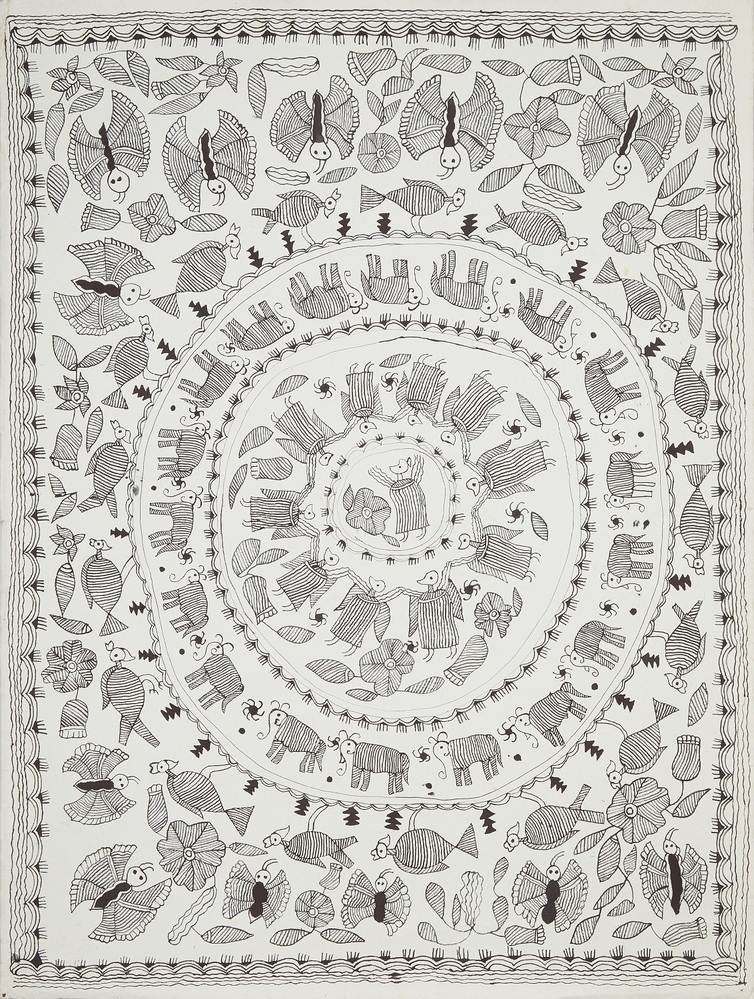
Mahanama Devi is a Dusadh* artist working mainly in the godna (tattoo) style of Mithila painting. Dusadh artists initially painted in the idioms of the Brahmin (priestly) or Kayastha (scribe) castes, predominantly depicting the Hindu pantheon and related themes, often reprimanded for doing so, as they were considered hors caste. In the 1970s, Erika Moser-Schmitt, a German anthropologist from Heidelberg University, encouraged Dusadh artists to explore their own idioms. Having observed that Dusadhs sported body tattoos, she suggested that they turn to their decorative and protective tattoo symbols and motifs. Gradually, Dusadh artists began to incorporate Dusadh legends and deities, gaining agency to challenge and subvert caste hierarchies through their artistic voice. Godna artworks tend to be filled with intricate lines, curlicues, concentric circles and motifs of flora and fauna, densely composed to cover the entire surface of the paper.
Raja Salhesh (also spelled Salhesa) – a deified, semi-mythological king – is the most important Dusadh hero. In Martine Le Coz’s retelling of his narrative, he is born as the high-born prince Jaybhardan, “destined to be a great warrior and king; instead, he questioned social inequalities and sought to establish a new, egalitarian kingdom in the mountains. Rather than being honored as a victorious warrior king, it is his quietly radical actions that appear to inspire.” [1/2] (cited by Das 2022: Essays 2) Other oral versions present Salhesh born as a Dusadh and overcoming caste prejudices to become a king. Etymologically, Salhesh means king of the mountains. Raja Salhesh’s garden occupies a central place in his narrative.
Although not identified as such, it is most likely Salhesh at the centre of Mahanama Devi’s Godna. Malin (flower maidens) are Salhesh’s admirers and significant figures in his legend. Indeed, the Phulbari Mela (festival of flowers) commemorating Salhesh in Mithila (across both India and Nepal) in April-May, is marked by his chief malin admirer, Dauna or Douna’s meeting with Salhesh. The first circle of figures around Salhesh are either malin or Salhesh himself, as Salhesh’s magical powers allow him to multiply himself so no malin will be deprived of his company. Moving outwards, the next circle shows elephants, possibly referencing Salhesh’s mount, an elephant. The outermost circle shows birds (either just birds in the garden or additionally referencing Hiraman, Salhesh’s parrot). At the outer edges, just within the borders, are butterflies, flowers and leaves.
Mahanama Devi received a National Award from the Government of India in 2017, for her outstanding contributions to the godna (tattoo) style of Mithila painting. The artist lives in Jitwarpur, home to many celebrated Dusadh Mithila artists.
*Dusadh: As with many oppressed peoples, the preferred terminology for self-identification has changed to reflect the continuing struggles for equality and social justice. Various terms have been used historically: Harijan (from the Sanskrit, meaning ‘children of god’, introduced and popularised by Mahatma Gandhi to refer to such castes); Dalit (from the Sanskrit, meaning ‘divided, split, broken, scattered’, first used to refer to such castes in the 1880s by the Marathi social activist Jyotirao Phule). Although specific sub-groups in Mithila now reportedly prefer the term Paswan, Dusadh (a term that has now come to mean ‘watchmen’) is used more widely.
Aurogeeta Das, 2024
References:
[1] Das, Aurogeeta (2022) “Flowers from the Earth” in Raja Salhesh’s Garden: Contemporary Dalit Art and Ancient Myths of Mithila – Volume 1, eds. John H. Bowles and Andrew S. Arbury, Radford: Radford University Art Museum and Radford University Foundation Press (eBook), pp. Essays 1-9
[2] Le Coz, Martine (2019) Le roi de la montagne: L’Épopée du Roi Salhesh, Paris: Éditions Massot
Selected exhibitions (that the artist’s work has featured in, not this particular artwork per se):
Raja Salhesh’s Garden: Contemporary Dalit Art and Ancient Myths of Mithila, India, Radford University Art Museum’s Covington Gallery, Radford (USA), 2022.


Not on display
Title/Description: Godna (Tattoo) Painting
Artist/Maker: Mahanama Devi
Born: 1988
Object Type: Painting (mithila)
Materials: Ink on handmade paper
Measurements: h. 558.8 x w. 762 mm
Inscription: Annotated ‘Mohanma Devi’, and titled ‘Godna Painting’ in Roman script, in ink, verso, top left corner.
Accession Number: 50899
Production Place: India
Credit Line: Donated by The Ethnic Arts Foundation