Wedding Ritual
Leela Devi
Life Story
The Mithila region covers a part of the northern state of Bihar in India and extends into the Terai lowlands of southern Nepal. Most Mithila artists today live in the Indian town of Madhubani and its surrounding villages, so Mithila art is sometimes termed Madhubani art. Literary references indicate that Mithila’s women were painting gods and goddesses on their homes’ interior walls at least as early as the 14th century. The images created for domestic rituals promoted fertility, abundance, marital felicity and family wellbeing. Mithila’s women used colours made from organic and mineral pigments, applying them to cow-dung and mud-plastered walls with simple bamboo and raw cotton brushes.
In 1934, following an earthquake near Madhubani, collapsed walls in the region revealed interior murals to the British colonial official William G Archer. Archer photographed many of these paintings through the 1930s, and in 1949 published an article about them in the Indian art journal, Mārg, bringing wider attention. In 1966-67, in the midst of a drought in Mithila, Pupul Jayakar came up with the idea to commission Mithila women to paint on paper, for sale, to support dwindling family incomes. Jayakar, at the time director of the All India Handicrafts Board and also Prime Minister Indira Gandhi’s cultural advisor, employed Bhaskar Kulkarni, a Bombay-based artist, to encourage Mithila’s women to transfer their wall paintings onto paper. This formed the genesis of what is known as Mithila art today. While initially centered on women from the upper castes (Kayastha and Brahmin), today, the practice extends to male artists and to many castes, including especially the oppressed Chamar and Dusadh castes.
Note: This text draws upon an essay by Aurogeeta Das and David Szanton in Das, Aurogeeta et al (2017) Many Visions, Many Versions: Art from Indigenous Communities in India, Washington D.C.: International Arts and Artists (IA&A), pp. 18-25
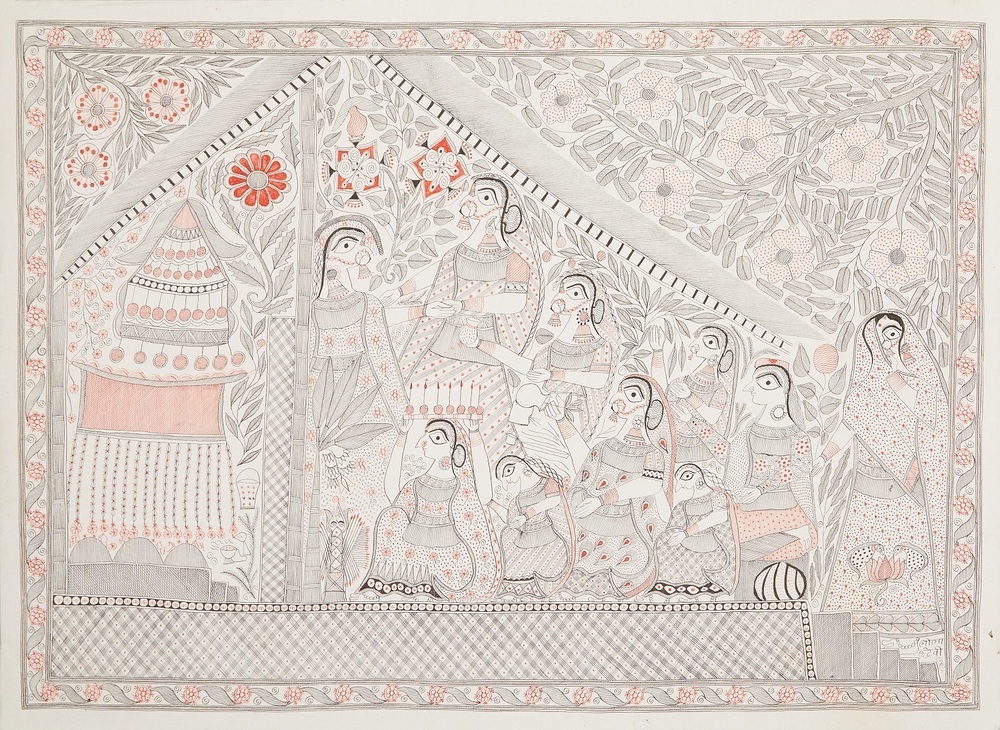
This drawing, executed in black and red ink, is rendered in Leela Devi’s characteristically delicate line work, in Mithila’s kachni (line-drawing) style. It depicts a Kayastha (caste of scribes and accountants) pre-wedding ritual, which takes place a day ahead of the main wedding ceremony.
Mithila artist Shashikala Devi explains that the woman seated facing the banana tree (towards bottom left) is the bride’s grandmother. She holds aloft her head a pidhiya (a wooden, rectangular seat). The circular objects atop the pidhiya are poori (fried, round Indian breads made with wheat flour). Each poori has a wooden stick inserted into it. Above each stick, there is a small diya (earthen lamp with oil or ghee, clarified butter, with a wick semi-soaked in the oil or ghee). Here, the diya are minimally rendered, making them look more like wicks than like lamps. The seven poori, sticks and diya symbolise the elders’ wish for the couple’s future marital togetherness, lasting seven lifetimes. The grandmother will carry the pidhiya while ‘walking’ on her knees to the gosaini or gosauni ghar (the room containing the family shrine in larger Mithila households). Four days after the main wedding ceremony, these objects are immersed into any water body close to the family residence (cited by Kaushik Kumar Jha in personal correspondence).
Directly above the bride’s grandmother is most likely the bride herself. The others in the wedding party include two women holding pots, one with grains and the other with auspicious leaves. On the bottom right is a blooming lotus being pecked by birds, which ties in with the lotus pond’s inclusion in kohbar ghar (conjugal chamber) murals’ symbolism. In keeping with kohbar ghar murals’ symbolism is the bans (bamboo) shown between the banana tree and the bride’s grandmother. As Jain explains, this symbol metaphorically represents the bridegroom and “epitomises the male regenerative energy . . . The bamboo plant . . . multiplies and spreads rapidly and has therefore become associated with male fertility”. [1] (1997: 57)On the left, there appear to be two partitions made of cloth, along with an oil lamp and diya as well as a bucket containing grains. These objects also relate to wedding rituals. As is common with Mithila drawings and paintings related to wedding rituals, floral and foliate forms adorn the background and the border, contributing to a general aesthetic of abundance.
The artist reportedly started learning Mithila art from the renowned Ganga Devi, in 1976. Her style thus shares affinities with Ganga Devi’s. Leela Devi received a State award from the government of Bihar in 1985 and a National Award for crafts from the central Government of India in 1987. The artist’s work is represented in Seattle Art Museum (USA).
Aurogeeta Das, 2024
References
[1] Jain, Jyotindra (1997) Ganga Devi: Tradition and Expression in Mithila Painting, Ahmedabad: Mapin Publishing
Selected exhibitions (that the artist’s work has featured in, not this particular artwork per se):
Tradition and Transformation: Mithila Art of India, William Benton Museum of Art, University of Connecticut, Mansfield (USA), 2022
Mithila Painting: Evolution of an Art Form, Syracuse University Art Galleries (USA), 2014


Not on display
Title/Description: Wedding Ritual
Artist/Maker: Leela Devi
Born: 2003
Object Type: Painting (mithila)
Materials: Ink on handmade paper
Measurements: h. 558.8 x w. 762 mm
Inscription: Signed ‘Leela Devi’ in Devanagari script, in ink, recto, bottom right corner, within the picture. Also annotated ‘Leela Devi’, with place name ‘Rashidpur’ and title ‘Wedding Ritual’, in Roman script, in ink, verso, bottom left corner.
Accession Number: 50896
Production Place: India
Credit Line: Donated by The Ethnic Arts Foundation