Rahu Ceremony
Lalita Devi
Life Story
The Mithila region covers a part of the northern state of Bihar in India and extends into the Terai lowlands of southern Nepal. Most Mithila artists today live in the Indian town of Madhubani and its surrounding villages, so Mithila art is sometimes termed Madhubani art. Literary references indicate that Mithila’s women were painting gods and goddesses on their homes’ interior walls at least as early as the 14th century. The images created for domestic rituals promoted fertility, abundance, marital felicity and family wellbeing. Mithila’s women used colours made from organic and mineral pigments, applying them to cow-dung and mud-plastered walls with simple bamboo and raw cotton brushes.
In 1934, following an earthquake near Madhubani, collapsed walls in the region revealed interior murals to the British colonial official William G Archer. Archer photographed many of these paintings through the 1930s, and in 1949 published an article about them in the Indian art journal, Mārg, bringing wider attention. In 1966-67, in the midst of a drought in Mithila, Pupul Jayakar came up with the idea to commission Mithila women to paint on paper, for sale, to support dwindling family incomes. Jayakar, at the time director of the All India Handicrafts Board and also Prime Minister Indira Gandhi’s cultural advisor, employed Bhaskar Kulkarni, a Bombay-based artist, to encourage Mithila’s women to transfer their wall paintings onto paper. This formed the genesis of what is known as Mithila art today. While initially centered on women from the upper castes (Kayastha and Brahmin), today, the practice extends to male artists and to many castes, including especially the oppressed Chamar and Dusadh castes.
Note: This text draws upon an essay by Aurogeeta Das and David Szanton in Das, Aurogeeta et al (2017) Many Visions, Many Versions: Art from Indigenous Communities in India, Washington D.C.: International Arts and Artists (IA&A), pp. 18-25
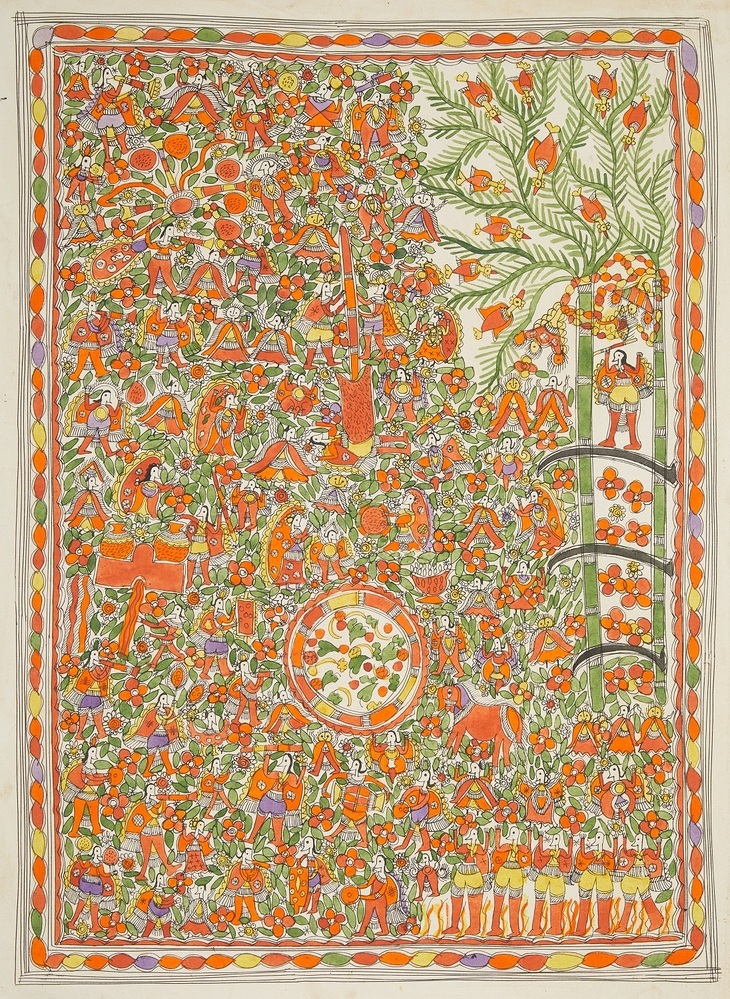
Like many of Mithila’s Dusadh* artists, Lalita Devi painted almost exclusively in the tattoo idiom, which was first pioneered among Jitwarpur’s Dusadhs by the artist Chano Devi in the 1970s. Lalita Devi’s ‘Rahu Ceremony’, also rendered in the tattoo idiom, shows several activities within the puja (worship ritual) propitiating the shadow planetary deity Rahu. Little is known about the worship of Rahu by Mithila’s Dusadh communities. Musicians are shown playing their instruments, among them several shehnai players (see top left). A reeded woodwind instrument typically played at weddings, the shehnai was considered a folk instrument until it was elevated to classical concert status by Ustad Bismillah Khan. Several drummers play the dhol (Indian percussion instrument), which is shown both in profile and front view (see bottom centre and bottom left, especially below the large ceremonial platter). Towards the top left are ceremonial plates offering foods and just below the painting’s centre is a large ceremonial platter. In other places, the preparation of ritual foods is shown. See, for example, the wood-burning, earthen hearth with two large cooking pots and a figure next to it stirring the food (middle left).
In many Indian artistic traditions, mortals are shown in profile, while deities are shown full face. In the scene’s hustle and bustle, including dancers and people walking in processions (shown in profile), note the few interspersed figures facing the viewer. These are bhagat (holy, shamanic men) and possibly also the bhagat’s helpers, the dhalwaha, who – as the divine’s representatives – are temporarily deified, and are thus shown full faced.
On the right, the trees are festooned and filled with birds, but they also show loudspeakers attached to the trunks’ tops, which probably play both music and relay the bhagat’s ceremonial chanting.
Three unusual scenes, described by the Mithila artist Uttam Prasad Paswan (1968-2020) in a text by Jyotindra Jain [1] (1995: 217), can be seen here. In the painting’s upper half, towards the centre, while in a state of possession, the bhagat lies down and allows grain to be pounded into a large mortar placed on his chest. To the painting’s right, a ladder made of naked swords hangs between the two tree trunks, which the bhagat climbs with bare feet. At the bottom right corner, devotees can be seen walking on a path of burning embers.
David Szanton has previously praised Lalita Devi’s “inventive inclusion of miscellaneous imagery – juxtaposing in a single picture” diverse elements and figures, including deities, people, wildlife, buildings and vehicles [2] (2022: Essays 16). Here too, the diverse aspects of Rahu’s worship converge into a single spatial frame, rendered in her habitually exuberant style.
*Dusadh: As with many oppressed peoples, the preferred terminology for self-identification has changed over time, reflecting the continuing struggles for equality and social justice. Various terms have been used historically: Harijan (from the Sanskrit, meaning ‘children of god’, introduced and popularised by Mahatma Gandhi to refer to such castes); Dalit (deriving from the Sanskrit, meaning ‘divided, split, broken, scattered’, first used to refer to such castes in the 1880s by the Marathi social activist Jyotirao Phule). Although specific sub-groups in Mithila now reportedly prefer the term Paswan, Dusadh (a term that has now come to mean ‘watchmen’) is used more widely.
Aurogeeta Das, 2024
References:
[1] Jain, Jyotindra (1995), “The Bridge of Vermillion: Narrative Rhythm in the Dusadh Legends of Mithila” in Indian Painting: Essays in Honour of Karl J. Khandalavala, eds. B. N. Goswamy and Usha Bhatia, New Delhi: Lalit Kala Akademi
[2] Szanton, David (2022), “Among Others: Mithila’s Dalit Art” in Raja Salhesh’s Garden: Contemporary Dalit Art and Ancient Myths of Mithila – Volume 1, Eds. John H. Bowles and Andrew S. Arbury, Radford: Radford University Art Museum and Radford University Foundation Press (eBook)
Selected exhibitions (that the artist’s work has featured in, not this particular artwork per se):
Raja Salhesh’s Garden: Contemporary Dalit Art and Ancient Myths of Mithila, India, Covington Gallery (Radford University Art Museum), Radford (USA), 2022
Tradition and Transformation: Mithila Art of India, William Benton Museum of Art, University of Connecticut, Mansfield (USA), 2022
Painting is my Everything: Art from India’s Mithila Region, Asian Art Museum, San Francisco (USA), 2018


Not on display
Title/Description: Rahu Ceremony
Artist/Maker: Lalita Devi
Born: 2004
Object Type: Painting (mithila)
Materials: Ink and natural colours on handmade paper
Technique: Painting
Measurements: h. 558.8 x w. 762 mm
Inscription: Annotated ‘Lalita Devi’ with place name, ‘Jitwarpur’ and titled ‘Rahu Ceremony’, in Roman script, in ink, verso, bottom right corner.
Accession Number: 50894
Production Place: India
Credit Line: Donated by The Ethnic Arts Foundation