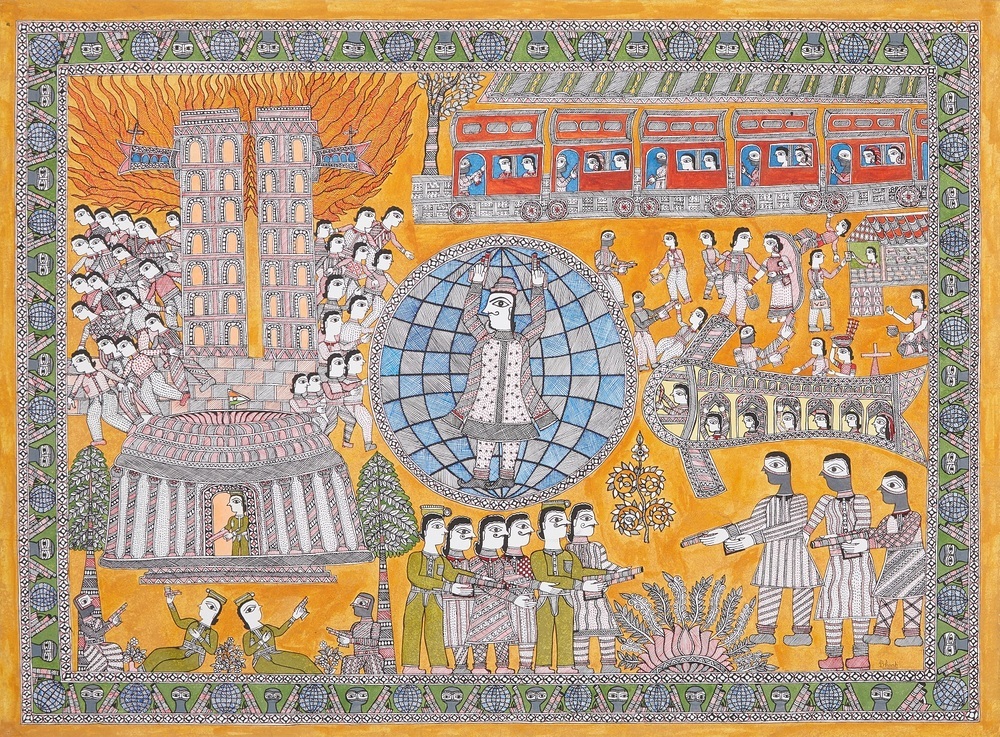
Terrorism
Bharti Kumari
Life Story
The Mithila region covers a part of the northern state of Bihar in India and extends into the Terai lowlands of southern Nepal. Most Mithila artists today live in the Indian town of Madhubani and its surrounding villages, so Mithila art is sometimes termed Madhubani art. Literary references indicate that Mithila’s women were painting gods and goddesses on their homes’ interior walls at least as early as the 14th century. The images created for domestic rituals promoted fertility, abundance, marital felicity and family wellbeing. Mithila’s women used colours made from organic and mineral pigments, applying them to cow-dung and mud-plastered walls with simple bamboo and raw cotton brushes.
In 1934, following an earthquake near Madhubani, collapsed walls in the region revealed interior murals to the British colonial official William G Archer. Archer photographed many of these paintings through the 1930s, and in 1949 published an article about them in the Indian art journal, Mārg, bringing wider attention. In 1966-67, in the midst of a drought in Mithila, Pupul Jayakar came up with the idea to commission Mithila women to paint on paper, for sale, to support dwindling family incomes. Jayakar, at the time director of the All India Handicrafts Board and also Prime Minister Indira Gandhi’s cultural advisor, employed Bhaskar Kulkarni, a Bombay-based artist, to encourage Mithila’s women to transfer their wall paintings onto paper. This formed the genesis of what is known as Mithila art today. While initially centered on women from the upper castes (Kayastha and Brahmin), today, the practice extends to male artists and to many castes, including especially the oppressed Chamar and Dusadh castes.
Note: This text draws upon an essay by Aurogeeta Das and David Szanton in Das, Aurogeeta et al (2017) Many Visions, Many Versions: Art from Indigenous Communities in India, Washington D.C.: International Arts and Artists (IA&A), pp. 18-25
Many Indian mural and floor-painting/floor-drawing traditions witnessed a gradual transfer to paper, some co-existing alongside the traditional domestic practices. In Mithila, the socioeconomic necessity that hastened the transfer introduced elements of radicalism, resulting in more socially engaged art. In other words, Mithila artists have more consciously practised ‘artivism’. Themes encompass environmental concerns, feminism (critiques of patriarchy, female foeticide and infanticide, and the dowry system), social inequity, and significant contemporary events, including natural disasters and terrorism. Such events are frequently situated beyond India’s borders, ‘consumed’ by these artists as subjects mediated by the international news media. Das and Szanton have previously written, “If power differentials between perceived centers and peripheries continue to play out politically, socio-economically, and culturally, such modern forces as the international news media, increased international mobility, and the internet are all contributing to ‘a globally shrinking village’ . . .” [1] (in Das et al 2017: 27)
Terrorism depicts at least three separate incidents: New York’s twin tower attacks (September 2001), most likely the Gujarat Pogrom, also referred to as the Gujarat Riots (February 2002) and New Delhi’s Parliament attacks (December 2001). On the top left are aeroplanes flying into the World Trade Centre and people fleeing the buildings in the attack’s aftermath. On the top right is probably the Gujarat Pogrom, which was reportedly instigated by the burning of a train in Godhra (Gujarat, India). Below the twin towers, on the left, is the attack on the Parliament of India, with India’s tricolour flag shown atop the building. Along the bottom are further scenes from this attack (with terrorists using grenades, AK-47 rifles and pistols), which resulted in – among others – the death of a gardener, indicated here by the shrub, trees and general foliage.
The border shows masked men holding rifles, a universally recognisable visual representing terrorism. In Mithila art, faces are usually shown in full frontal mode when they are divine; mortals are shown in profile. Here, the faces on the border face the viewer, perhaps to draw attention to how only the terrorists’ eyes are visible when they wear concealing masks, thus highlighting the terrorists’ menacing ‘gaze’. In 2012, three years after she created this painting, another Mithila artist, Naresh Paswan created a work in ink titled 9/11/2001, which captured the moment when the first plane struck the North Tower, with the Hudson River showing in the background. When discussing the Gond artist Venkat Singh Shyam’s series Terror in Mumbai (2010), Das made an observation that is pertinent to the eyes in the border here: “The recurring symbol of the eye underscores the mass horror felt by the global audience watching these events unfolding on television (recalling the terrifying and dramatic sight of the collapsing twin towers on 9/11), as though the artist’s firsthand ‘gaze’ is shared by television viewers . . . The omnipresent eye also introduces a sinister element by consciously – or unwittingly – pointing to issues of surveillance, such as the apparent ubiquity of security cameras (which, on this occasion at least, clearly – and ironically – did not provide adequate security).” [1] (ibid, 28) By juxtaposing diverse terrorist incidents, the artist underscores terrorism’s unfortunate prevalence in the 21st century.
Aurogeeta Das, 2024
References:
[1] Das, Aurogeeta and David Szanton, “The Contemporary Moment in Indigenous Art: Global Events and Sociopolitical Critiques” in Das, Aurogeeta et al (2017) Many Visions, Many Versions: Art from Indigenous Communities in India, Washington D.C.: International Arts and Artists (IA&A), pp. 26-31


Not on display
Title/Description: Terrorism
Artist/Maker: Bharti Kumari
Born: 2009
Object Type: Painting (mithila)
Materials: Ink and natural colours on handmade paper
Measurements: h. 558.8 x w. 762 mm
Inscription: Signed Bharti, in Roman script, in ink, recto, bottom right corner, within the picture.
Accession Number: 50893
Production Place: India
Credit Line: Donated by The Ethnic Arts Foundation