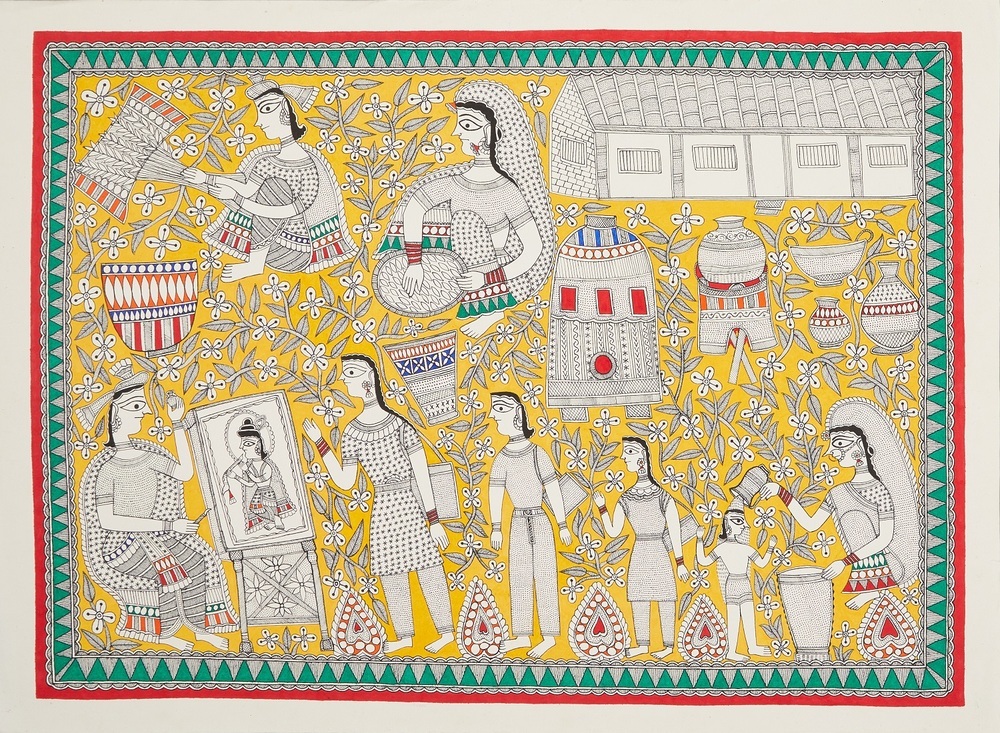
Artist and his Family
Gopal Saha
Life Story
The Mithila region covers a part of the northern state of Bihar in India and extends into the Terai lowlands of southern Nepal. Most Mithila artists today live in the Indian town of Madhubani and its surrounding villages, so Mithila art is sometimes termed Madhubani art. Literary references indicate that Mithila’s women were painting gods and goddesses on their homes’ interior walls at least as early as the 14th century. The images created for domestic rituals promoted fertility, abundance, marital felicity and family wellbeing. Mithila’s women used colours made from organic and mineral pigments, applying them to cow-dung and mud-plastered walls with simple bamboo and raw cotton brushes.
In 1934, following an earthquake near Madhubani, collapsed walls in the region revealed interior murals to the British colonial official William G Archer. Archer photographed many of these paintings through the 1930s, and in 1949 published an article about them in the Indian art journal, Mārg, bringing wider attention. In 1966-67, in the midst of a drought in Mithila, Pupul Jayakar came up with the idea to commission Mithila women to paint on paper, for sale, to support dwindling family incomes. Jayakar, at the time director of the All India Handicrafts Board and also Prime Minister Indira Gandhi’s cultural advisor, employed Bhaskar Kulkarni, a Bombay-based artist, to encourage Mithila’s women to transfer their wall paintings onto paper. This formed the genesis of what is known as Mithila art today. While initially centered on women from the upper castes (Kayastha and Brahmin), today, the practice extends to male artists and to many castes, including especially the oppressed Chamar and Dusadh castes.
Note: This text draws upon an essay by Aurogeeta Das and David Szanton in Das, Aurogeeta et al (2017) Many Visions, Many Versions: Art from Indigenous Communities in India, Washington D.C.: International Arts and Artists (IA&A), pp. 18-25
The top right corner shows an exterior view of Saha’s bungalow. On the top left corner are figures carrying out domestic chores. One is most likely separating the wheat from the chaff, while another is cleaning rice grains by flicking out stones and dirt out of the basket. The decorative pots shown below these women are probably for food storage, though the one on the left might equally be a bamboo or rattan woven basket (shaped like a dustpan) used for cleaning grains. The tiny rectangular shape below it could be either a handle (if it’s a basket) or an earthen pot stand, if it’s a cooking pot. On the right, below the bungalow, are various cooking utensils, including a large grain storage pot towards the painting’s centre. Next to it is a cooking pot on a wood-fired clay hearth. At the bottom right corner, a woman bathes a child Indian style, by using a lota (little metal pot), which she dips into a bucket of water and pours over the child’s head. At the bottom left corner, the artist is shown making a painting of the Hindu god Krishna, identifiable by the flute he plays, the peacock feather in his hair, and his posture with ankles crossed, seen with a halo. The three figures in the middle, wearing western clothes, are customers who visit the artist’s studio to view and purchase his art. According to Mithila art scholar David Szanton, Saha is the only Mithila artist who frequently portrayed himself in his paintings [1] (2017: 88).
The background is delicately filled with flowers. Saha’s style appears to be a blend of kachni (line work) and bharni (colourful and densely patterned) styles, leaning towards the former as only the coloured background makes the painting more vibrant. Yet, the use of the floral patterns in the background and the decorative motifs shaped like leaves of the peepal tree (sacred fig, binomial name: Ficus religiosa) between the various figures at the bottom also indicate his taste for the bharni style.
Saha tends to use only 3-4 colours in each painting, the limited palette drawing attention to the figures in what are most often snapshots of life, though Saha has also painted scenes from the Hindu epics. His penchant is for conveying narrative, whether mythological, biographical or in vignette style. Sometimes, these observations pertain to village life and at other times, the artist portrays himself in his paintings, enabling a glimpse into his life as a Mithila artist. Saha was disabled in his lower limbs, and it may be that limited mobility sharpened his observational abilities. Scenes from life that he has previously depicted included overcrowded buses that rolled past his home in Madhubani, floods, a cricket match, and foreign buyers purchasing his works. As Szanton has previously stated, the artist frequently casts an amused or sardonic eye in such paintings [1] (ibid, 91).
Saha’s work can be found in the Asian Art Museum of San Francisco and the Philadelphia Museum of Art (both USA).
Aurogeeta Das, 2024
References:
[1] Szanton, David in Das, Aurogeeta et al (2017) Many Visions, Many Versions: Art from Indigenous Communities in India, Washington D.C.: International Arts and Artists (IA&A)
Selected exhibitions (that the artist’s work has featured in, not this particular artwork per se):
Many Visions, Many Versions: Art from Indigenous Communities in India, multiple venues in the USA and Canada, 2017-2020
Painting is my Everything: Art from India’s Mithila Region, Asian Art Museum, San Francisco (USA), 2018
Peintures de Madhubani et du Mithila, Amboise (France), 2015
The Extraordinary Evolution of Mithila Painting: From Ritual to Politics, India Community Center, Milpitas (USA), 2008
Mithila Painting: The Evolution of an Art Form, Museum of Craft and Folk Art, San Francisco (USA), 2005
Baua Devi and the Art of Mithila, Berkeley Art Museum, Berkeley (USA), 199


Not on display
Title/Description: Artist and his Family
Artist/Maker: Gopal Saha
Born: 2003
Object Type: Painting (mithila)
Materials: Ink and natural colours on handmade paper
Measurements: h. 558.8 x w. 762 mm
Accession Number: 50887
Production Place: India
Credit Line: Donated by The Ethnic Arts Foundation