Jhijhiya Dance
Vinita Jha
Life Story
The Mithila region covers a part of the northern state of Bihar in India and extends into the Terai lowlands of southern Nepal. Most Mithila artists today live in the Indian town of Madhubani and its surrounding villages, so Mithila art is sometimes termed Madhubani art. Literary references indicate that Mithila’s women were painting gods and goddesses on their homes’ interior walls at least as early as the 14th century. The images created for domestic rituals promoted fertility, abundance, marital felicity and family wellbeing. Mithila’s women used colours made from organic and mineral pigments, applying them to cow-dung and mud-plastered walls with simple bamboo and raw cotton brushes.
In 1934, following an earthquake near Madhubani, collapsed walls in the region revealed interior murals to the British colonial official William G Archer. Archer photographed many of these paintings through the 1930s, and in 1949 published an article about them in the Indian art journal, Mārg, bringing wider attention. In 1966-67, in the midst of a drought in Mithila, Pupul Jayakar came up with the idea to commission Mithila women to paint on paper, for sale, to support dwindling family incomes. Jayakar, at the time director of the All India Handicrafts Board and also Prime Minister Indira Gandhi’s cultural advisor, employed Bhaskar Kulkarni, a Bombay-based artist, to encourage Mithila’s women to transfer their wall paintings onto paper. This formed the genesis of what is known as Mithila art today. While initially centered on women from the upper castes (Kayastha and Brahmin), today, the practice extends to male artists and to many castes, including especially the oppressed Chamar and Dusadh castes.
Note: This text draws upon an essay by Aurogeeta Das and David Szanton in Das, Aurogeeta et al (2017) Many Visions, Many Versions: Art from Indigenous Communities in India, Washington D.C.: International Arts and Artists (IA&A), pp. 18-25
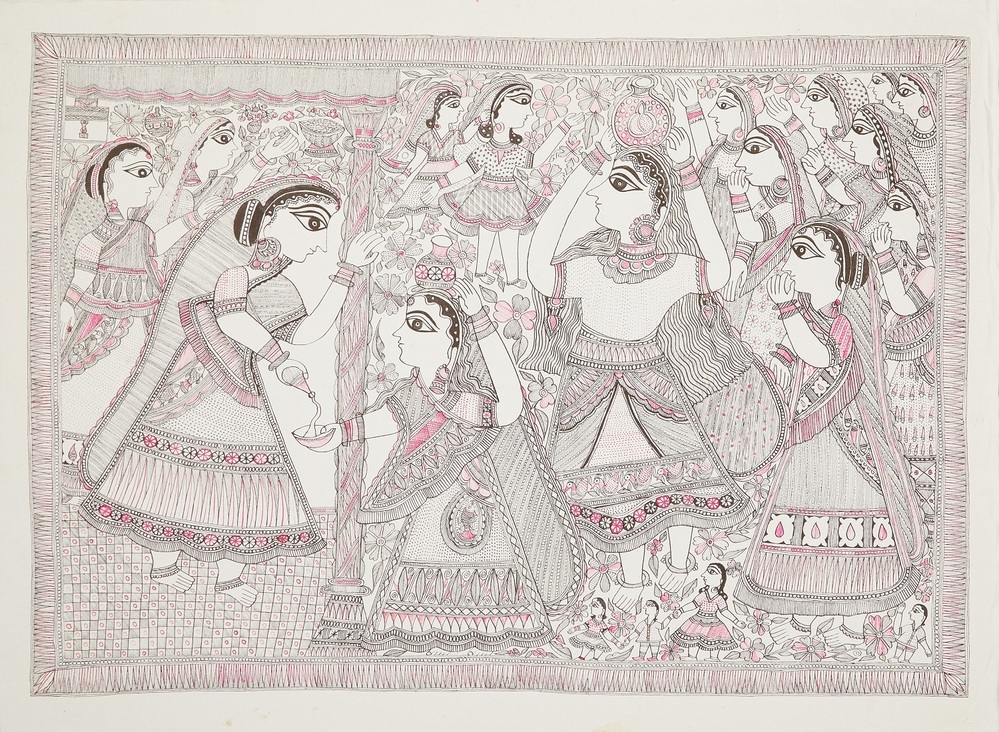
Performed by girls during the Dussehra festival in the lunar month of Ashwin (September-October in the Gregorian calendar), Jhijhiya propitiates the goddess Durga, whose martial yet benevolent powers are believed to protect worshippers from sorcery and evil spirits.
Jhijhiyais performed across Mithila (both in India and Nepal) to the accompaniment of regionally specific musical instruments and songs. It is performed for ten consecutive evenings in a group of ten to fifteen girls, traditionally in front of different houses, with the dancers asking the residents of each house for grains and other offerings. It starts formally on the day of Ghatasthapana, which involves the placement of a kalash (consecrated pot filled with water or grains and topped with auspicious fruit and leaves). For Ghatasthapana, grains are sown into the kalash. The day is named after the pot (ghata means ‘pot’, sthapana means ‘placement’). The dances end on the day of Vijaya Dashami (in eastern India, sometimes spelled Bijaya Dashami) when the offered grains and foods are gathered, a feast is prepared and partaken communally. Mirroring the kalash are earthen pots that the dancers place on their heads; for Jhijhiya, these are generally perforated, with diya (earthen oil lamps) placed inside. During the dark evenings, the dancers’ movements thus produce enchanting effects with dappled lights and moving shadows. As with many traditional customs, increasingly, Jhijhiya competitions are organised in allocated spaces, rather than having the dancers move from house to house, with competition dances incorporating a more commercialised aesthetic.
In this delicately drawn work in black and dull red, children and women watch as the dancers enact customs related to Jhijhiya. The pillar to the left demarcates a veranda space, from where a lady offers her contributions to the dancers, represented by the girl in front of the group, balancing an earthen pot on her head. At the group’s centre, another girl balances on her head a perforated and lit pot. At the veranda’s top right corner is a pot with grains. While such artworks document cultures that are changing or dying out, thus constituting sociocultural records, these might prove to be mixed blessings.
Vinita Sinha writes of the losses experienced when such traditions wane or change: “Another example of the feminine oral is the dance of Jhijhiya. Once again the woman takes charge of propitiating the deities for the well-being of the family and the society. In Mithila, the birthplace of virtuous Sita, this is also a celebration dance to celebrate the return of Rama after His victory over the evil Ravana. . . .
Performances such as these in free spaces in rural areas are slowly dying. The effort to resurrect them are mostly in staged performances in urban areas.” [1] (2018: 147-148) Sinha further suggests that as rural migrants gradually get urbanised, such rituals become mere anecdotes in oral histories, leading to consequent risks, i.e. the staged performances might come to be recognised as the primary art form. With the custom’s original ritual context being lost, the recording – be it a painting, video or text – becomes the key reference point for new practitioners, “which may even prevent organic development of the art form. This fear is likely extended to translations which often find a larger audience than the original and thus become the primary source of information”. [1] (ibid: 148)
See Szanton and Bakshi (2007: 58-59) for another example of the artist’s work. Also see Goenka, Tula and Susan Wadley (producers) (2020) Vinita Jha (filmed by Karan Talwar, edited by Sim Hothi) [2]
Aurogeeta Das, 2024
References:
[1] Sinha, Vinita (2018) “The Invaluable Oral: Trajectories of genesis, challenges and longevity” in Manas: Cultures and Societies of South, East and Southeast Asia: Traditionalism, Dynamics and Globalization, 4:2
[2] Szanton, David and Malini Bakshi (2007) Mithila Painting: the Evolution of an Art Form, Berkeley: Ethnic Arts Foundation in association with Pink Mango
Selected exhibitions (that the artist’s work has featured in, not this particular artwork per se):
Deeply Rooted: The Tree of Life, Alexey von Schlippe Gallery, The University of Connecticut, Avery Point (USA), 2023
Tradition and Transformation: Mithila Art of India, William Benton Museum of Art, University of Connecticut, Mansfield (USA), 2022
Painting is my Everything: Art from India’s Mithila Region, Asian Art Museum, San Francisco (USA), 2018


Not on display
Title/Description: Jhijhiya Dance
Artist/Maker: Vinita Jha
Born: 2000
Object Type: Painting (mithila)
Materials: Ink on handmade paper
Measurements: h. 558.8 x w. 762 mm
Accession Number: 50881
Production Place: India
Credit Line: Donated by The Ethnic Arts Foundation