Bull
Shanti Devi
Life Story
The Mithila region covers a part of the northern state of Bihar in India and extends into the Terai lowlands of southern Nepal. Most Mithila artists today live in the Indian town of Madhubani and its surrounding villages, so Mithila art is sometimes termed Madhubani art. Literary references indicate that Mithila’s women were painting gods and goddesses on their homes’ interior walls at least as early as the 14th century. The images created for domestic rituals promoted fertility, abundance, marital felicity and family wellbeing. Mithila’s women used colours made from organic and mineral pigments, applying them to cow-dung and mud-plastered walls with simple bamboo and raw cotton brushes.
In 1934, following an earthquake near Madhubani, collapsed walls in the region revealed interior murals to the British colonial official William G Archer. Archer photographed many of these paintings through the 1930s, and in 1949 published an article about them in the Indian art journal, Mārg, bringing wider attention. In 1966-67, in the midst of a drought in Mithila, Pupul Jayakar came up with the idea to commission Mithila women to paint on paper, for sale, to support dwindling family incomes. Jayakar, at the time director of the All India Handicrafts Board and also Prime Minister Indira Gandhi’s cultural advisor, employed Bhaskar Kulkarni, a Bombay-based artist, to encourage Mithila’s women to transfer their wall paintings onto paper. This formed the genesis of what is known as Mithila art today. While initially centered on women from the upper castes (Kayastha and Brahmin), today, the practice extends to male artists and to many castes, including especially the oppressed Chamar and Dusadh castes.
Note: This text draws upon an essay by Aurogeeta Das and David Szanton in Das, Aurogeeta et al (2017) Many Visions, Many Versions: Art from Indigenous Communities in India, Washington D.C.: International Arts and Artists (IA&A), pp. 18-25
Shanti Devi is now the foremost proponent of the Chamar* artist Jamuna Devi’s dot-painting style (if not the only one, excepting the latter’s daughter-in-law Binda Devi). Szanton explains how Jamuna Devi began by painting Hindu deities, “but soon differentiated her work by placing rows of black dots between the traditionally doubled lines around figures in Brahmin paintings. In the process she established a new ‘dot painting’ style, akin to the dots extensively used in the Dusadh* wall paintings.” [1] (2022: Essays 17) A skilful colourist like Jamuna Devi, Shanti Devi similarly favours a vibrant palette.
Shanti Devi had to work hard to find her idiom. Mithila art scholar Mani Shekhar Singh asserts that this was partly due to Dusadh and Chamar artists being omitted in the government’s efforts to champion Mithila painting on paper. “By modeling her paintings on those of Sita Devi, Shanti Devi hoped for recognition and entry into the emerging market for Mithila/Madhubani painting. The art world initially had a very limited notion of what constituted authentic Maithil [adjective for Mithila] art. When Pupul Jayakar as the Chairman of the AIHB [All India Handicrafts Board] presented eleven examples of the ‘best’ specimens of Mithila paintings in 1975 to the India Office Library, London, to bolster the existing Archer Collection, they were all paintings by Brahmin and Kayastha women.” [2] (forthcoming, n.p.)
The struggle was also partly due to Dusadh painters first turning to unfamiliar upper caste themes and narratives, in the absence of their own aesthetic traditions. This changed first with the government representative Bhaskar Kulkarni encouraging Dusadh artists (countering his instructions to focus on upper caste artists) to paint on paper and thereafter by his counselling them to turn to their own themes. Jamuna Devi was at the forefront of these changes, though the Dusadh artist Chano Devi, in the 1970s, would likewise adopt the tattoo idiom at the urging of the German anthropologist Erika Moser-Schmitt. Being a second-generation Dalit* artist, Shanti Devi benefitted from these two stalwarts, cherry-picking techniques – double lines filled with dots, bharni (traditional, densely filled style) – and amalgamating them into her idiom.
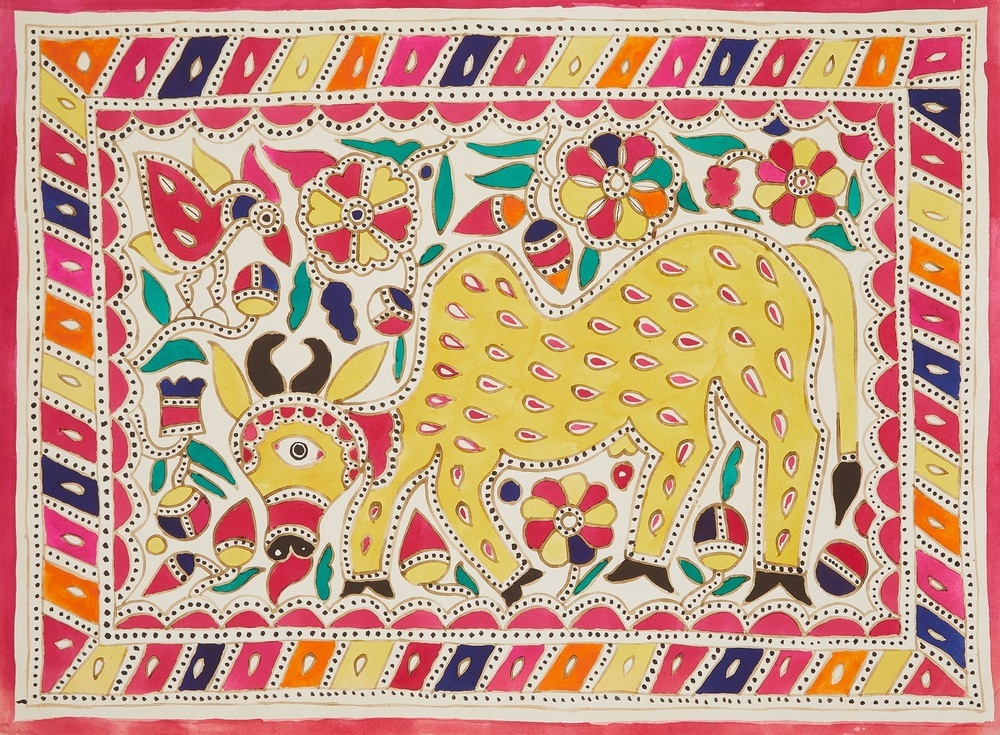
Here, she uses the dots (which make the painting ‘sparkle’) and a vivid palette to show a bull chewing on a leaf, while a bird, perched on a branch above, looks on. The background’s florals and foliates, and the decorative border, in this sensitive observation of nature, might recall Jamuna Devi’s idiom but Shanti Devi transforms it into her own with her confident, graphic lines. Background elements that floated in Jamuna Devi’s works, take on a more ‘stamped’ look here.
For her contributions to Mithila art, Shanti Devi received a Padma Shri in 2024. She had previously received the National Merit Award from the Government of India, in 2012, for Mithila Painting. She lives and works in the village of Laheriya Ganj in Madhubani district (Bihar, India).
Her work is represented in Radford University Art Museum, Radford (USA), and Mithila Museum (Japan), among others.
*Chamar are leatherworkers, including tanners, for instance. Due to the nature of their work, dealing with ‘dead’ animal skins, like the Dusadh (watchmen and agricultural labourers), the Chamar were (sadly, still are) considered hors caste. Such castes are collectively often termed ‘Dalit’. Marathi social activist Jyotirao Phule first used this term in the 1880s; from the Sanskrit, it means ‘divided, split, broken, scattered’.
Aurogeeta Das, 2024
References:
[1] Szanton, David (2022) “Among Others: Mithila’s Dalit Art” in Raja Salhesh’s Garden: Contemporary Dalit Art and Ancient Myths of Mithila – Volume 1, eds. John H. Bowles and Andrew S. Arbury, Radford: Radford University Art Museum and Radford University Foundation Press (eBook), pp. Essays 14-21
[2] Singh, Mani Shekhar (forthcoming, 2025), “Color, Rhythm, and Repetition in Paintings by Dalit Women of Mithila” in India’s Mithila Painting, eds. David L. Szanton and Paula Richman, Seattle: University of Washington Press
Selected exhibitions (that the artist’s work has featured in, not this particular artwork per se):
Raja Salhesh’s Garden: Contemporary Dalit Art and Ancient Myths of Mithila, India, Covington Gallery (Radford University Art Museum), Radford (USA), 2022
Mithila Medley: Contemporary Arts from an Ancient Culture in North India, Floyd Center for the Arts, Floyd (USA), 2022
Many Visions, Many Versions: Art from Indigenous Communities in India, multiple venues in the USA and Canada, 2017-2020
Painting is my Everything: Art from India’s Mithila Region, Asian Art Museum, San Francisco (USA) 2018
Mithila Painting: The Evolution of an Art Form, Museum of Craft and Folk Art, San Francisco (USA) 2005
Shanti Devi: Madhubani/Forest of Honey, City Gallery Wellington, Wellington (New Zealand), 2005


Not on display
Title/Description: Bull
Artist/Maker: Shanti Devi
Born: 1977
Object Type: Painting (mithila)
Materials: Ink and natural colours on handmade paper
Measurements: h. 558.8 x w. 762 mm
Inscription: Annotated ‘Shanti Devi’, with place name Laheriya Ganj’ and titled ‘A bull’ in Roman script, in ink, verso. Also verso, an ink stamp reads ‘Secretary, MASTER CRAFTSMAN’S ASSOCIATION OF MITHILA, Jitwarpur, Madhubani, BIHAR, INDIA.
Accession Number: 50880
Production Place: India
Credit Line: Donated by The Ethnic Arts Foundation