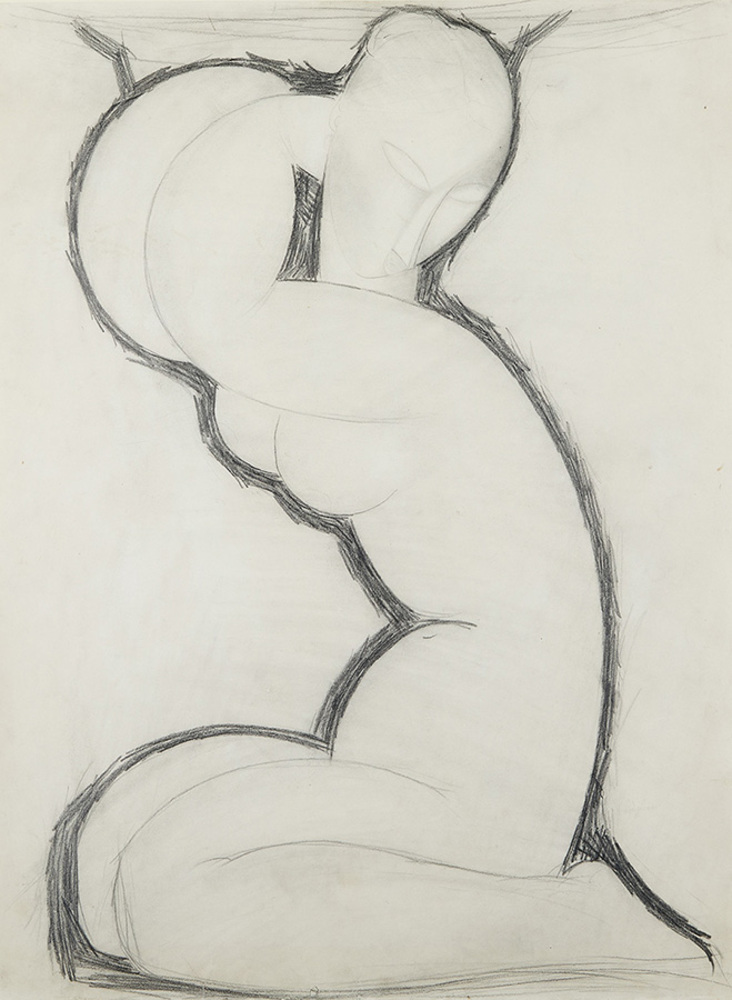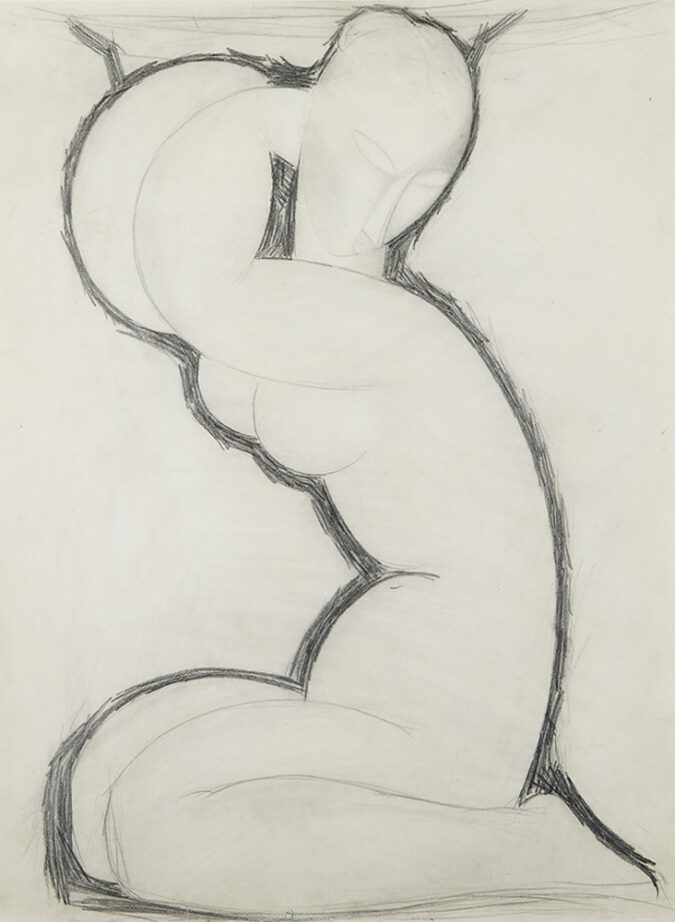
Caryatid
Amedeo Modigliani
Life Story
Amedeo Modigliani is primarily known as a painter though he predominantly made sculpture between 1909 and 1914, producing twenty-eight known sculptures [see L.234]. Towards the end of this period, between 1912 and 1914, he made over seventy Caryatid drawings. These relate to his sculptural ambition to create a secular ‘temple to humanity’ surrounded by caryatid sculptures, in which female figures would act as ‘columns of tenderness’. Only one sculpture is known on the subject, a carving now in the Museum of Modern Art, New York, yet the related drawings represent some of his most impressive works on paper. These drawings are created from the imagination, though Modigliani also liked to draw from life.
Modigliani’s interest in caryatids was both formal and symbolic:
“Modigliani was enchanted by these figures – at once real and unreal – whose inflexibility, imposed by their functional role, is relieved by the fantasy of their being atlantes or idealized women.” [1]
Each drawing depicts a woman with her arms raised to the height of her head to support a weight extending beyond the top of the paper. The first of these drawings were more expressive, whereas from 1912 they became more geometric. Most in the latter group are kneeling. Each body is rendered in round curves, echoing Modigliani’s famed approach to representing facial features with simple lines across his drawing, painting and sculpture. The present drawing is rendered in such curves, with heavier shading around its perimeter, emphasising a solid mass. The internal lines are created with pencil and the dark outlines delineated in a softer crayon. Beyond the outline there is almost no shading within the body and very little on the face.
The approach to representing the face in simple geometries suggests it is a sculpture or mask rather than a representation of a real person. Similar approaches to representing the face can be seen in Modigliani’s studies of African sculpture from 1909, his earliest known body of drawings that were created after he was introduced to African sculpture by his patron Paul Alexandre.
Amedeo Clemente Modigliani (1884–1920) was born in Italy where he spent his childhood. He moved to Paris in 1906 where he met avant-garde artists such as Pierre-Auguste Renoir, Pablo Picasso and Constantin Brâncuşi. He achieved little success in his lifetime though he was included in the prestigious Salon d’Automne exhibition in 1912. He died young at the age of 35 and achieved fame after his death.
Tania Moore, December 2025
[1] Noël; Alexandre, The Unknown Modigliani: Drawings from the collection of Paul Alexandre (New York: Harry N. Abrams Inc., 1993), p.189.
Exhibitions
'Magdalene Odundo: The Journey of Things', The Hepworth Wakefield, 2/2019 - 6/2019
'Magdalene Odundo: The Journey of Things', Sainsbury Centre, Norwich, 8/2019 - 12/2019
'Pablo Picasso: The Legacy of Youth', Sainsbury Centre, Norwich, 13/3/2022 - 17/7/2022
Provenance
Purchased by Robert and Lisa Sainsbury from Galerie Zak circa 1939.
Donated to the Sainsbury Centre, University of East Anglia in 1973 as part of the original gift.


On display
Title/Description: Caryatid
Artist/Maker: Amedeo Modigliani
Born: 1913 c.
Object Type: Drawing
Materials: Crayon, Paper, Pencil
Measurements: Unframed: (h. 650 x w. 480 x d.1 mm) Framed: (h. 870 x w. 695 x d. 30 mm)
Accession Number: 14
Historic Period: 20th century
Production Place: Europe, France
Credit Line: Donated by Robert and Lisa Sainsbury, 1973