Mahakali
Krishnanand Jha
Life Story
The Mithila region covers a part of the northern state of Bihar in India and extends into the Terai lowlands of southern Nepal. Most Mithila artists today live in the Indian town of Madhubani and its surrounding villages, so Mithila art is sometimes termed Madhubani art. Literary references indicate that Mithila’s women were painting gods and goddesses on their homes’ interior walls at least as early as the 14th century. The images created for domestic rituals promoted fertility, abundance, marital felicity and family wellbeing. Mithila’s women used colours made from organic and mineral pigments, applying them to cow-dung and mud-plastered walls with simple bamboo and raw cotton brushes.
In 1934, following an earthquake near Madhubani, collapsed walls in the region revealed interior murals to the British colonial official William G Archer. Archer photographed many of these paintings through the 1930s, and in 1949 published an article about them in the Indian art journal, Mārg, bringing wider attention. In 1966-67, in the midst of a drought in Mithila, Pupul Jayakar came up with the idea to commission Mithila women to paint on paper, for sale, to support dwindling family incomes. Jayakar, at the time director of the All India Handicrafts Board and also Prime Minister Indira Gandhi’s cultural advisor, employed Bhaskar Kulkarni, a Bombay-based artist, to encourage Mithila’s women to transfer their wall paintings onto paper. This formed the genesis of what is known as Mithila art today. While initially centered on women from the upper castes (Kayastha and Brahmin), today, the practice extends to male artists and to many castes, including especially the oppressed Chamar and Dusadh castes.
Note: This text draws upon an essay by Aurogeeta Das and David Szanton in Das, Aurogeeta et al (2017) Many Visions, Many Versions: Art from Indigenous Communities in India, Washington D.C.: International Arts and Artists (IA&A), pp. 18-25
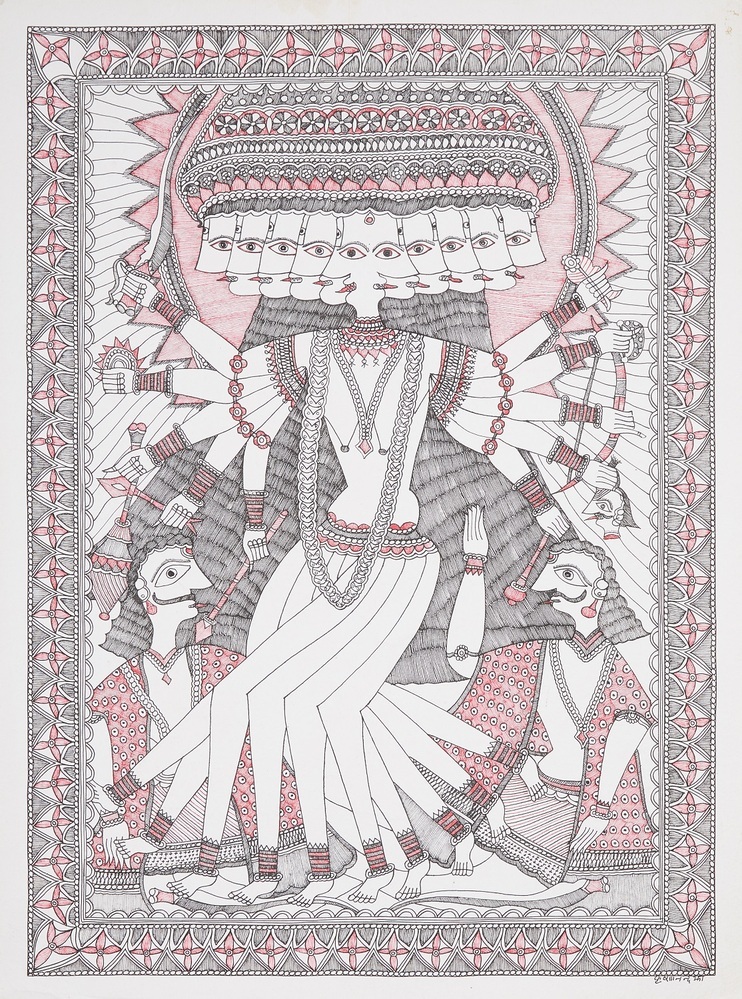
Krishnanand Jha’s drawing in ink Mahakali presents the terrible, emaciated goddess as an icon, with 10 legs, arms and faces with protruding tongues. The male figures flanking her are most likely the demons Chanda and Munda (from whom she derives her variant name Chamunda). This is not certain, however, as she appears to also be holding a decapitated head (right, fourth hand from the top), which may or may not be the head of either demon. In other hands, she holds a chakra (spiked, wheel-shaped weapon, in her second hand from the top on the left), a mace (third hand from the top on the left), an arrow or small spear (fourth hand from the top, on the left), a spear (fifth hand from the top, on the left), a fish-shaped knife (first hand from the top, on the right), a khadga (crescent-shaped sword or sickle, second hand from the top, on the right), a bow (third hand from the top, on the right), the decapitated head (as above) and a mace (fifth hand from the top, right). Generally, Kali’s iconography includes her holding a sword, but here, two swords appear to be lying at her feet. Her emaciation is especially visible in her breasts. She wears an elaborate crown, armlets, anklets and bangles, and is shown haloed.
According to art collector and writer Gursharan Sidhu, Krishnanand Jha was the earliest prominent male Mithila artist (followed by Gopal Saha and Santosh Kumar Das). He favoured the Tantric style among the six Mithila styles identified by the art historian Neel Rekha: Tantric, Kachni, Bharni, Godna, Geru and Gobar [1] (2011: 22). Hailing from a once affluent Brahmin family of Tantric practitioners, he was most likely influenced by his father Digambar Jha, a successful, commercial Tantric artist, and his uncle Batohi Jha (whose work appears in Pupul Jayakar’s The Earthen Drum [2] (see e.g., fig.6, pp. xviii-1). Sidhu writes that Jha became skilful not only at iconic representations drawing upon the Tantric idiom but also at drawing episodes from the epics and classic tales. His iconic representations focussed especially on the deities within the Tantric and Shaivite belief. His thematic range was not limited to religious paintings, as evidenced by his series of drawings depicting the murder of Phool Jha. Sidhu also references his autobiographical drawings, “Digambar Jha could not support his family on the produce of the remaining land, so Krishnanand Jha was enrolled in college in Calcutta and earned a bachelor of arts degree, intended to prepare him for office work. He failed to find employment and in disgust threw his diploma into the Ganges. . . . He also did a five-painting series of his own life story, from his birth to his return from Calcutta, including an image of himself on his knees destroying his diplomas.” [3] (forthcoming, n.p.) The artist died in 2018 after suffering from Parkinson’s for two decades.
Aurogeeta Das, 2024
References:
[1] Rekha, Neel (December 2011) “Maithil Paintings: An Enquiry into its [sic] Historiographical Trajectory (1947-1997)” in Folklore and Folkloristics, 4:2, Howrah
[2] Jayakar, Pupul (1980) The Earthen Drum: An introduction to the Ritual Arts of Rural India, New Delhi: National Museum
[3] Sidhu, Gursharan (forthcoming, 2025) “The Murder of Phool Jha in Krishnanand Jha’s Drawings” in India’s Mithila Painting, eds. David L. Szanton and Paula Richman, Seattle: University of Washington Press
Selected exhibitions (that the artist’s work has featured in, not this particular artwork per se):
Painting is my Everything: Art from India’s Mithila Region, Asian Art Museum, San Francisco (USA), 2018


Not on display
Title/Description: Mahakali
Artist/Maker: Krishnanand Jha
Born: 1980
Object Type: Painting (mithila)
Materials: Ink and natural colours on handmade paper
Measurements: h. 558.8 x w. 762 mm
Inscription: Signed Krishnanand Jha, in Devanagari script, in ink, recto, bottom right corner. Titled ‘Maha Kali’, in Roman script, in ink, verso.
Accession Number: 50900
Production Place: India
Credit Line: Donated by The Ethnic Arts Foundation