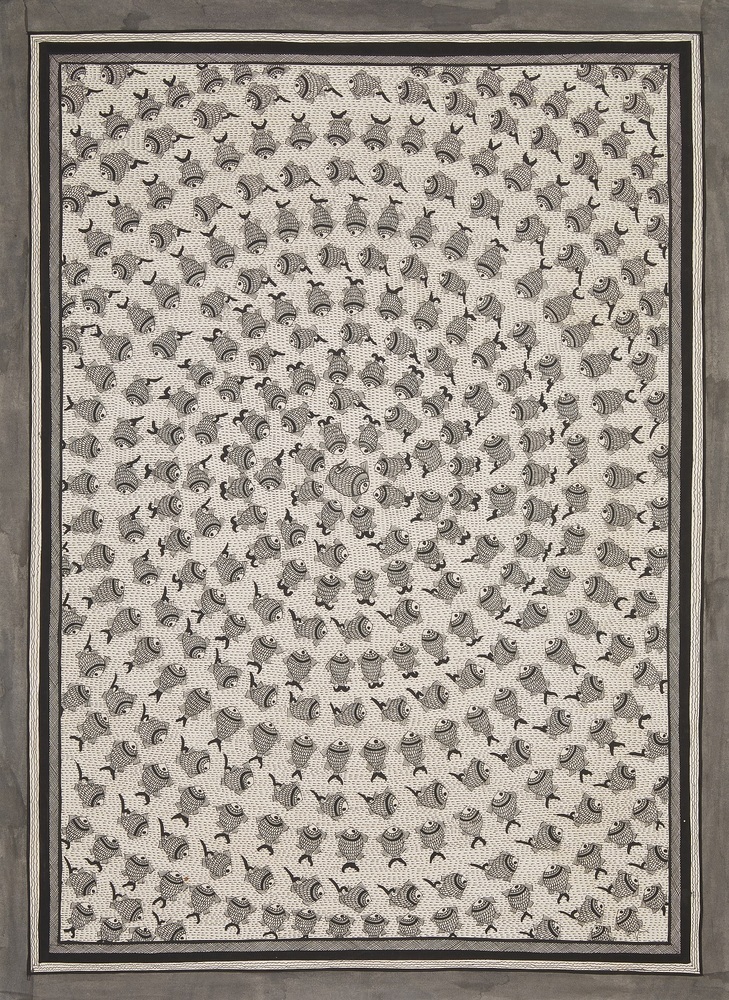
Fish Mandala
Ranjan Paswan
Life Story
The Mithila region covers a part of the northern state of Bihar in India and extends into the Terai lowlands of southern Nepal. Most Mithila artists today live in the Indian town of Madhubani and its surrounding villages, so Mithila art is sometimes termed Madhubani art. Literary references indicate that Mithila’s women were painting gods and goddesses on their homes’ interior walls at least as early as the 14th century. The images created for domestic rituals promoted fertility, abundance, marital felicity and family wellbeing. Mithila’s women used colours made from organic and mineral pigments, applying them to cow-dung and mud-plastered walls with simple bamboo and raw cotton brushes.
In 1934, following an earthquake near Madhubani, collapsed walls in the region revealed interior murals to the British colonial official William G Archer. Archer photographed many of these paintings through the 1930s, and in 1949 published an article about them in the Indian art journal, Mārg, bringing wider attention. In 1966-67, in the midst of a drought in Mithila, Pupul Jayakar came up with the idea to commission Mithila women to paint on paper, for sale, to support dwindling family incomes. Jayakar, at the time director of the All India Handicrafts Board and also Prime Minister Indira Gandhi’s cultural advisor, employed Bhaskar Kulkarni, a Bombay-based artist, to encourage Mithila’s women to transfer their wall paintings onto paper. This formed the genesis of what is known as Mithila art today. While initially centered on women from the upper castes (Kayastha and Brahmin), today, the practice extends to male artists and to many castes, including especially the oppressed Chamar and Dusadh castes.
Note: This text draws upon an essay by Aurogeeta Das and David Szanton in Das, Aurogeeta et al (2017) Many Visions, Many Versions: Art from Indigenous Communities in India, Washington D.C.: International Arts and Artists (IA&A), pp. 18-25
Being the grandson of Sarup Lal Paswan, and the son of Raj Kumar Paswan and his first wife, the late Lalita Devi, Ranjan Paswan is a third generation Mithila artist. His extended family includes not only his grandfather but also his great uncles (Sarup Lal Paswan’s brothers) Uttam Prasad Paswan and Roudi Paswan (and by marriage to Roudi Paswan, his great aunt Chano Devi); each has had literature focusing on their oeuvres. Other notable Mithila artists in his family include Indu Devi, Rampari Devi and Poonam Devi. [1] (Bowles 2022: Catalog 15)
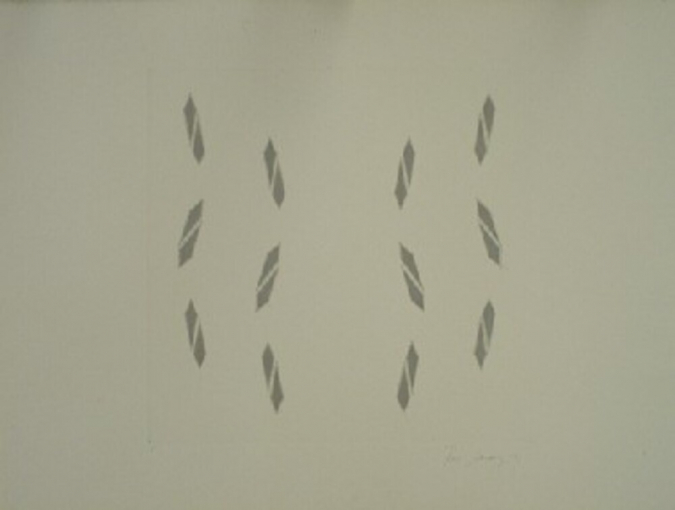
Given his relationship with the founders of the godna style of Mithila painting, Roudi Paswan and Chano Devi, it is perhaps not surprising that Ranjan adopts the style with ease (though he does not exclusively express himself in the godna style). Artworks executed in the godna style tend to be filled with intricate lines, curlicues, concentric circles and motifs of flora and fauna, densely composed to cover the entire surface of the paper. Here, concentric circles of fish swimming in water are presented in alternate lines, facing inwards towards the centre or moving clockwise. It is this change in directionality between alternate lines that introduces subtle dynamism into the composition.
In Mithila art, fish are a common symbol of abundance. As Das and Szanton have previously written: “[Mithila] captures much of the snowmelt from the Himalayas, as well as runoff from the annual monsoon. The region is basically flat, with many rivers flowing south to the Ganges. The soil is rich but also readily subject to floods. Its thousands of natural and dug ponds are filled with both lotus blossoms and schools of fish that are a major source of protein. In their abundance, the fish have become symbols of fecundity and elegance of form, and – along with other forms of water life – are frequent subjects in Mithila paintings.” [2] (in Das et al 2017: 78) Mithila consists of two regions: hilly and Terai (foothills), hence the flatness alludes to the Terai region.
Aurgeeta Das, 2024
References:
[1] Bowles, John H. and Andrew S. Arbury (eds.) (2022), Raja Salhesh’s Garden: Contemporary Dalit Art and Ancient Myths of Mithila – Volume 1, Radford: Radford University Art Museum and Radford University Foundation Press (eBook)
[2] Szanton, David in Das, Aurogeeta et al (2017) Many Visions, Many Versions: Art from Indigenous Communities in India, Washington D.C.: International Arts and Artists (IA&A)
Filmography:
Gómez, Carlos G (director) and Coralynn V. Davis (producer) (2023) Sama in the Forest, 75 min, in English and Maithili (in collaboration with M. S. Suman and Kaushik Kumar Jha)
Selected exhibitions (that the artist’s work has featured in, not this particular artwork per se):
Painting is my Everything: Art from India’s Mithila Region, Asian Art Museum, San Francisco (USA), 2018


Not on display
Title/Description: Fish Mandala
Artist/Maker: Ranjan Paswan
Born: 2019
Object Type: Painting (mithila)
Materials: Ink
Measurements: h. 558.8 x w. 762 mm
Accession Number: 50888
Production Place: India
Credit Line: Donated by The Ethnic Arts Foundation