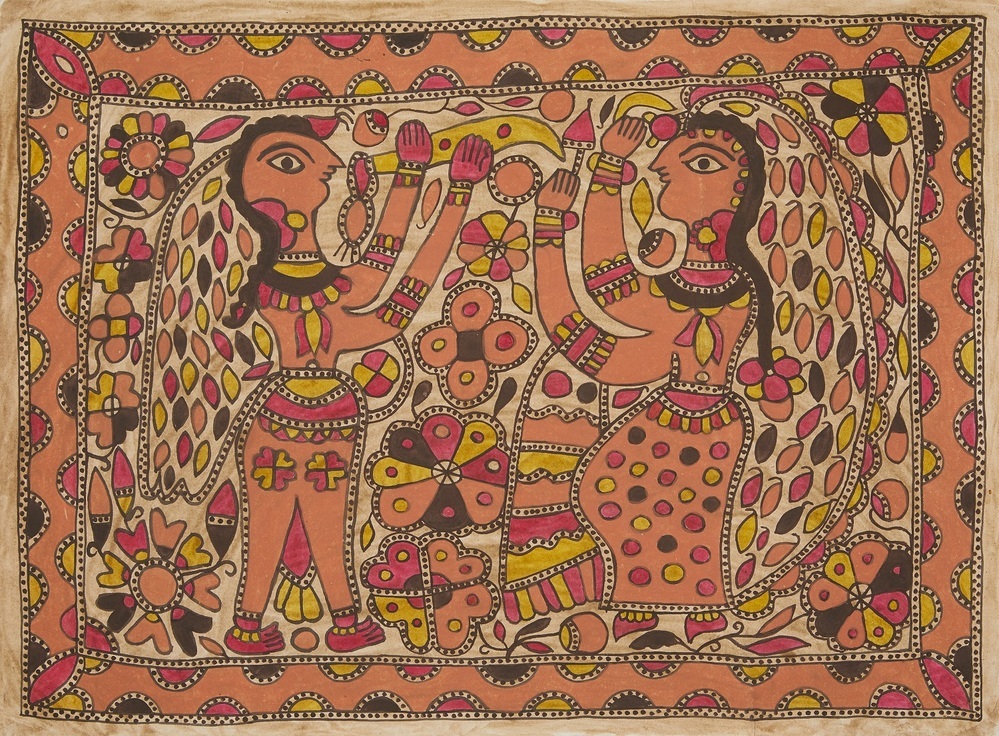
Motiram, Salhesh’s Brother, Fighting with Panma
Jamuna Devi
Life Story
The Mithila region covers a part of the northern state of Bihar in India and extends into the Terai lowlands of southern Nepal. Most Mithila artists today live in the Indian town of Madhubani and its surrounding villages, so Mithila art is sometimes termed Madhubani art. Literary references indicate that Mithila’s women were painting gods and goddesses on their homes’ interior walls at least as early as the 14th century. The images created for domestic rituals promoted fertility, abundance, marital felicity and family wellbeing. Mithila’s women used colours made from organic and mineral pigments, applying them to cow-dung and mud-plastered walls with simple bamboo and raw cotton brushes.
In 1934, following an earthquake near Madhubani, collapsed walls in the region revealed interior murals to the British colonial official William G Archer. Archer photographed many of these paintings through the 1930s, and in 1949 published an article about them in the Indian art journal, Mārg, bringing wider attention. In 1966-67, in the midst of a drought in Mithila, Pupul Jayakar came up with the idea to commission Mithila women to paint on paper, for sale, to support dwindling family incomes. Jayakar, at the time director of the All India Handicrafts Board and also Prime Minister Indira Gandhi’s cultural advisor, employed Bhaskar Kulkarni, a Bombay-based artist, to encourage Mithila’s women to transfer their wall paintings onto paper. This formed the genesis of what is known as Mithila art today. While initially centered on women from the upper castes (Kayastha and Brahmin), today, the practice extends to male artists and to many castes, including especially the oppressed Chamar and Dusadh castes.
Note: This text draws upon an essay by Aurogeeta Das and David Szanton in Das, Aurogeeta et al (2017) Many Visions, Many Versions: Art from Indigenous Communities in India, Washington D.C.: International Arts and Artists (IA&A), pp. 18-25
Jamuna Devi is credited with being the first Mithila artist to start using a diluted cow dung wash on paper. In the traditional Mithila murals, a cow dung wash is applied first, before a mural is created. She was the first Dalit** artist who engaged with Raja Salhesh (a hero for the subaltern) as a subject worthy of artistic exploration. In 1987, Jamuna Devi also became the first Dalit artist from Mithila to receive a national award from the central Government of India. Jamuna Devi’s extraordinary career of innovations and firsts is especially remarkable because she hailed from the Chamar** community, who were traditionally considered hors caste in the Hindu caste system and were thus oppressed.
Raja Salhesh (also spelled Salhesa) – a deified, semi-mythological king – is the most important Dalit hero in Mithila. In Martine Le Coz’s retelling of the Salhesh narrative, he is born as “the high-born prince Jaybhardan, destined to be a great warrior and king. Instead, he questioned social inequalities and sought to establish a new, egalitarian kingdom in the mountains. Rather than being honored as a victorious warrior king, it is his quietly radical actions that appear to inspire.” [1/2] (referenced by Das 2022: Essays 2) Other oral versions present Salhesh born as a Dusadh, overcoming caste prejudices to become a king. Here, two characters from his legend are engaged in a confrontation, with Motiram (Salhesh’s brother) shown wielding a sword. As is characteristic of Jamuna Devi’s signature style, the central figures appear against a background of floating floral forms and other motifs, framed by a decorative border, sporting a vibrant palette, and enlivened with Jamuna Devi’s virtuoso application of dots. Szanton writes how the artist was encouraged by Bhaskar Kulkarni, who – although specifically tasked with encouraging upper caste artists – was so excited by her evident talent in murals and bas-reliefs that he encouraged her initial transfer to paper. Jamuna Devi began by painting Hindu deities, “but soon differentiated her work by placing rows of black dots between the traditionally doubled lines around figures in Brahmin paintings. In the process she established a new ‘dot painting’ style, akin to the dots extensively used in the Dusadh wall paintings.” [3] (2022: Essays 17)
Less common is the artist’s use of geru (red ochre) in this painting. The author Neel Rekha refers to ‘short-lived’ geru style of paintings in her historiographical analysis of Maithil (adjective for Mithila) paintings [4] (2011: 8). While other styles she refers to are characterised by idiomatic preferences, the geru and gobar styles are defined by their use of materials (red ochre and cow-dung respectively).
The artist’s work is represented in Radford University Art Museum, Radford (USA), among others.
*The title ‘Srimati’ indicates a woman’s married status. Unlike in certain cultures where an equivalent title such as ‘Mrs.’ would usually be followed by the husband’s family name, in Mithila and other Indian cultures, the generic suffix ‘Devi’ is appended to the woman’s first name, to further indicate the bearer’s marital status.
**Chamar are leatherworkers, including tanners, for instance. Due to the nature of their work, dealing with ‘dead’ animal skins, like the Dusadh (watchmen and agricultural labourers) and Chandala (those who bury corpses), the Chamar were (sadly, still are) considered hors caste. Such castes are collectively often termed ‘Dalit’. Marathi social activist Jyotirao Phule first used this term in the 1880s; from the Sanskrit, it means ‘divided, split, broken, scattered’.
Aurogeeta Das, 2024
References:
[1] Le Coz, Martine (2019) Le roi de la montagne: L’Épopée du Roi Salhesh, Paris: Éditions Massot (in French)
[2] Das, Aurogeeta (2022) “Flowers from the Earth” in Raja Salhesh’s Garden: Contemporary Dalit Art and Ancient Myths of Mithila – Volume 1, eds. John H. Bowles and Andrew S. Arbury, Radford: Radford University Art Museum and Radford University Foundation Press (eBook), pp. Essays 1-9
[3] Szanton, David (2022) “Among Others: Mithila’s Dalit Art” in Raja Salhesh’s Garden: Contemporary Dalit Art and Ancient Myths of Mithila – Volume 1, eds. John H. Bowles and Andrew S. Arbury, Radford: Radford University Art Museum and Radford University Foundation Press (eBook), pp. Essays 14-21
[4] Rekha, Neel (December 2011) “Maithil Paintings: An Enquiry into its [sic] Historiographical Trajectory (1947-1997)” in Folklore and Folkloristics, 4:2, Howrah
Selected exhibitions (that the artist’s work has featured in, not this particular artwork per se):
Raja Salhesh’s Garden: Contemporary Dalit Art and Ancient Myths of Mithila, India, Covington Gallery (Radford University Art Museum), Radford (USA), 2022
Martine le Coz: A French Homage to the Ancient Myths and Contemporary Artists of Mithila, Tyler Gallery (Radford University Art Museum), Radford (USA), 2022
Mithila Medley: Contemporary Arts from an Ancient Culture in North India, Floyd Center for the Arts, Floyd (USA), 2022
Many Visions, Many Versions: Art from Indigenous Communities in India, multiple venues in the USA and Canada, 2017-2020
Painting is my Everything: Art from India’s Mithila Region, Asian Art Museum, San Francisco (USA), 2018
Mithila Painting: The Evolution of an Art Form, Museum of Craft and Folk Art, San Francisco (USA), 2005
Mithila Painting, Indian Consulate, Durban (South Africa), 2004
Baua Devi and the Art of Mithila, Berkeley Art Museum, Berkeley (USA), 1997


Not on display
Title/Description: Motiram, Salhesh’s Brother, Fighting with Panma
Artist/Maker: Jamuna Devi
Born: 1982
Object Type: Painting (mithila)
Materials: Red ochre and natural colours on handmade paper
Technique: Painting
Measurements: h. 558.8 x w. 762 mm
Inscription: Signed ‘Srimati Yamuna Devi’, further identified as ‘wife of Sri Ram Ji Ram’, and addressed as ‘Village PO Jitwarpur, Zila [District] Madhubani’, in Devanagari script, dated ‘1981’ in Roman script, in ink, verso, top left corner
Accession Number: 50885
Production Place: India
Credit Line: Donated by The Ethnic Arts Foundation