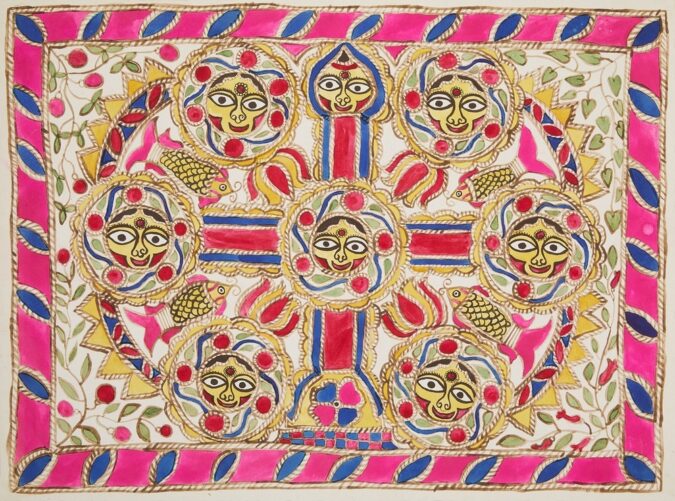
Kohbar
Devi, Premlata
Life Story
The Mithila region covers a part of the northern state of Bihar in India and extends into the Terai lowlands of southern Nepal. Most Mithila artists today live in the Indian town of Madhubani and its surrounding villages, so Mithila art is sometimes termed Madhubani art. Literary references indicate that Mithila’s women were painting gods and goddesses on their homes’ interior walls at least as early as the 14th century. The images created for domestic rituals promoted fertility, abundance, marital felicity and family wellbeing. Mithila’s women used colours made from organic and mineral pigments, applying them to cow-dung and mud-plastered walls with simple bamboo and raw cotton brushes.
In 1934, following an earthquake near Madhubani, collapsed walls in the region revealed interior murals to the British colonial official William G Archer. Archer photographed many of these paintings through the 1930s, and in 1949 published an article about them in the Indian art journal, Mārg, bringing wider attention. In 1966-67, in the midst of a drought in Mithila, Pupul Jayakar came up with the idea to commission Mithila women to paint on paper, for sale, to support dwindling family incomes. Jayakar, at the time director of the All India Handicrafts Board and also Prime Minister Indira Gandhi’s cultural advisor, employed Bhaskar Kulkarni, a Bombay-based artist, to encourage Mithila’s women to transfer their wall paintings onto paper. This formed the genesis of what is known as Mithila art today. While initially centered on women from the upper castes (Kayastha and Brahmin), today, the practice extends to male artists and to many castes, including especially the oppressed Chamar and Dusadh castes.
Note: This text draws upon an essay by Aurogeeta Das and David Szanton in Das, Aurogeeta et al (2017) Many Visions, Many Versions: Art from Indigenous Communities in India, Washington D.C.: International Arts and Artists (IA&A), pp. 18-25
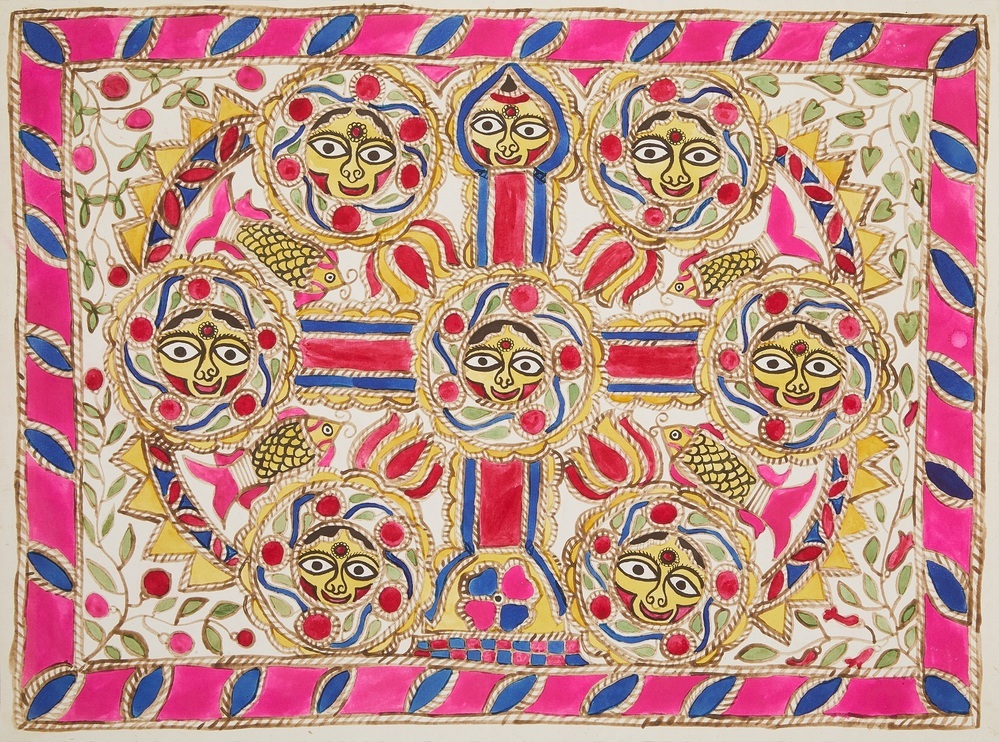
The kohbar image derives its name from the kohbar ghar (conjugal chamber) in the Mithila region of Bihar, India. This is where the bride and groom spend their first few nights immediately after their wedding. The murals painted for the occasion in this chamber originally gave birth to the region’s mural painting tradition. Doubtless, there would have been other kinds of murals painted in the region, but these kohbar ghar murals form the genesis of the contemporary painting on paper referred to as Mithila art today.
One of the interpretations of the traditional motifs and symbols painted in the kohbar murals is that it is a symbolic representation of male and female fertility, with a lotus pond symbolising women’s fertility and the bamboo grove (perhaps because of bamboo’s upright growth) symbolising male potency. Both together additionally also generally symbolise the earth’s fertility. Other common motifs that form a part of the kohbar tableau include a representation of the bride and groom, an idealised divine couple (nowadays usually Shiva and Parvati), the sun, the moon, the chequered mat that the bridal couple sleep on, and other wedding accoutrements, such as the kalas, auspicious pot filled with auspicious grains and other foods. Premlata Devi’s vibrantly coloured kohbar pares down this tableau to just a lotus pond showing both lotuses and women’s faces, with lush foliage surrounding the pond. The fish in the pond are a general symbol of abundance and fertility favoured by Mithila artists. It is possible that the underlying, stylised central axes here do symbolise bamboo as several artists often conflate the bamboo grove and the lotus pond, while others arrange them separately within the painting space. Within the borders, at bottom centre, note the chequered mat forming the bridal seat.
The artist uses just five colours (excluding black), all derived from natural colours. It is uncertain which natural colours the artist would have used. Based on a comprehensive list compiled by Vidyanath Jha, of pigments that the Mithila painters obtain from seeds, roots, rhizomes, leaves, wood, flowers, bracts, and fruits, one could surmise that she might have used black from the jau seed (Hordeum vulgare), green from the bel leaf (Aegle marmelos), yellow either from turmeric or from the genda (marigold) flower (Tagetes erecta), red from the poro seed (Basella rubra) and blue from the nil leaf (Indigoferia tinctoria). [1] (Jha 2002: 42-43)
Aurogeeta Das, 2024
References:
[1] Jha, Vidyanath (2002) “Indigenous Colours in Mithila (North Bihar) – A Historical Perspective” in Indian Journal of History of Science, 37:1, New Delhi: Indian National Science Academy, pp. 37-55


Not on display
Title/Description: Kohbar
Born: 1981
Object Type: Painting (mithila)
Materials: Ink and natural colours on handmade paper
Measurements: h. 558.8 x w. 762 mm
Inscription: Annotated ‘Premlata Devi, C/O Shyam Chandra Das, Village & PO Ranti, Distt [District] Madhubani’, in Roman script, in ink, verso, top left corner.
Accession Number: 50882
Production Place: India
Credit Line: Donated by The Ethnic Arts Foundation