Can the Seas Survive Us?
Please note that this season of exhibitions and events has now passed. It took place from 15 March to 26 October 2025.
The future of our oceans was explored in the Sainsbury Centre’s extensive 2025 exhibition programme
As sea levels rise, oceans are also warming, becoming more acidic and containing less oxygen. The United Nations describe the oceans as “overwhelmed” as humans overfish, pollute, and destroy habitats, with the ocean’s health declining at an “alarming rate”. Featuring contemporary art, historical paintings, ancient atlases and maps from across the globe, the season explores humanity’s enduring and complex relationship with the sea.
Three concurrent exhibitions in Can the Seas Survive Us?, examined the choices shaping our future due to climate change, while emphasising the vital importance of the oceans and the life beneath the waves for the viability of our shared future.
A World of Water
15 March – 3 August 2025
A day at the seaside or rain at Wimbledon. So much of our shared experience of the British summer involves water. But what would the world be like without water, or more critically, without our seas and oceans and all the lifeforce within it? The Sainsbury Centre aims to unlock a sense of urgency, recognising that the precarious nature of our waters, and possible geopolitical conflicts caused by them, will be as significant in this century as oil was in the 20th.
A World of Water brought together works by British and international artists from the last 250 years who have all offered a unique perspective of evolving marine ecosystems and oceanic habitats. Taking the North Sea and the historical relationship between Norfolk and the Netherlands as its starting point, the exhibition looked at the human impact on the sea.
The exhibition encouraged visitors to understand the complexity of sea and marine life, whilst encouraging a collective, global effort to mitigate the impacts of climate change and support action to restore marine ecosystems.
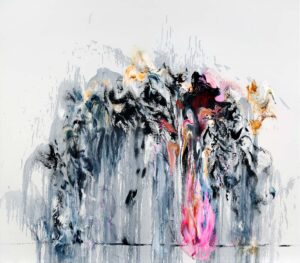
Image: Maggi Hambling, Wall of Water VIII, 2011, oil on canvas. Copyright Maggi Hambling.
Supported by: The Dutch Embassy, Art Fund, John Ellerman Foundation, Hudson Architects, Arts Council England




Darwin in Paradise Camp: Yuki Kihara
15 March – 3 August 2025
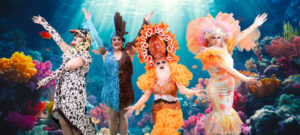
The Sainsbury Centre hosted the UK premiere of Paradise Camp, a celebrated work by Yuki Kihara (b.1975), an interdisciplinary artist of Sāmoan and Japanese descent, which was exhibited alongside newly commissioned work titled Darwin Drag.
Previously presented at the Aotearoa New Zealand Pavilion in the 59th Venice Biennale in 2022, Paradise Camp upcycled the works of French painter Paul Gauguin (1848–1903). Kihara recasted past narratives by using Fa’afafine models – a third gender community in Sāmoa, to which Kihara also belongs – in colourful, hyperreal photographs reflecting Gauguin’s compositions. Darwin in Paradise Camp featured original works by Gauguin alongside Kihara’s Paradise Camp for the very first time.
The exhibition foregrounds how a closer relationship between humanity and the seas can save the communities most at risk of the human-caused impact on the seas, as well as the seas themselves
Image: Darwin Drag (2025) by Yuki Kihara. Courtesy of Yuki Kihara and Milford Galleries, Aotearoa New Zealand.
Supported by: British Council and AHRC Impact Acceleration Account administered by UEA.

Sea Inside
7 June – 26 October 2025
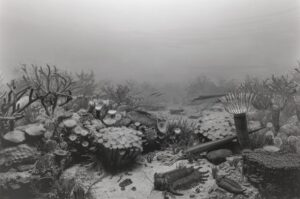
Have you ever wondered what it feels like to live underwater, to be inside a shell, or even the belly of a whale?
While some humans have pursued life above or under water – through seafaring, research, fishing or diving – others have and still are subjected to the horrors of forced or desperate maritime crossings. Yet the sea has often been viewed as a mysterious ‘other’, with its expansive surface and seemingly infinite depths dominating marine imagery in the history of Western art. Conversely, artworks in this exhibition explored the ways the oceans have been domesticated, reimagined on a bodily scale and brought inside to be tamed, contained or better understood.
Sea Inside turned our oceanic gaze towards the sea’s more intimate spaces – whether physical, psychological or imaginary – and dives into shared watery origins, Indigenous ways of life and the items we remove from the sea to display on land.
Image: Hiroshi Sugimoto, Devonian Period, 1992. Copyright: Hiroshi Sugimoto, courtesy of Lisson Gallery.
Supported by: Hudson Architects.
De Onkruidenier: Coastal Kin

De Onkruidenier carried out a residency as part of the Can the Seas Survive Us? season, collaborating with Norfolk coastal communities to facilitate meaningful exchange and community activations. The Dutch collective, who describe themselves as Ecosystem Futurists, create new narratives to reinterpret the relationship between humans and nature, both above and below sea level.
Curated by John Kenneth Paranada
Image: de Onkruidenier, Relearning Aquatic Evolution, 2022 © Marleen Annema.
Supported by Wolterton and Arts Council England
Director of the Sainsbury Centre, Jago Cooper, says: “The oceans cover more than 70% of the planet; it is the life source of the natural world, an eternal expanse of more than a billion cubic kilometres of marine habitat. Yet what do these seas say about the state of nature today and our relationship with it? From wind farms populating the North Sea and plastics filling the Pacific, to toxic algal blooms appearing and beautiful creatures disappearing, what really lies below the surface of these stories and ultimately: Can the Seas Survive Us?”
This trio of exhibitions considered the seas’ fluidity as a powerful metaphor; ranging from our need to navigate a way through turbulent times, to champion and learn from Indigenous knowledge, seize the opportunities presented by the sea as a regenerative, sustainable energy source, recognising its relentless, destructive power in ways that are crucially felt and experienced by low-lying small island nations such as the Maldives and Kiribati, along with coastal communities, including several here in Norfolk.
Space for Dialogue
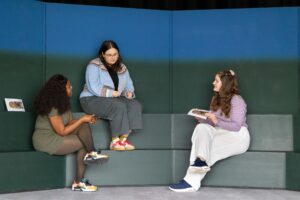
As we explored the question Can the Seas Survive Us?, we discussed how we can address the urgent issues facing our planet without becoming overwhelmed? How can we connect with others and move into a space of active hope? What can we do to really make a difference?
To address these questions we worked with artists, local community activists and third-sector organisations to develop a programme of inclusive and friendly dialogues. Visitors were encouraged to join us in the galleries and in our specially-made Space for Dialogue where we shared our stories, spoke from the heart, and planned together.
Image top:
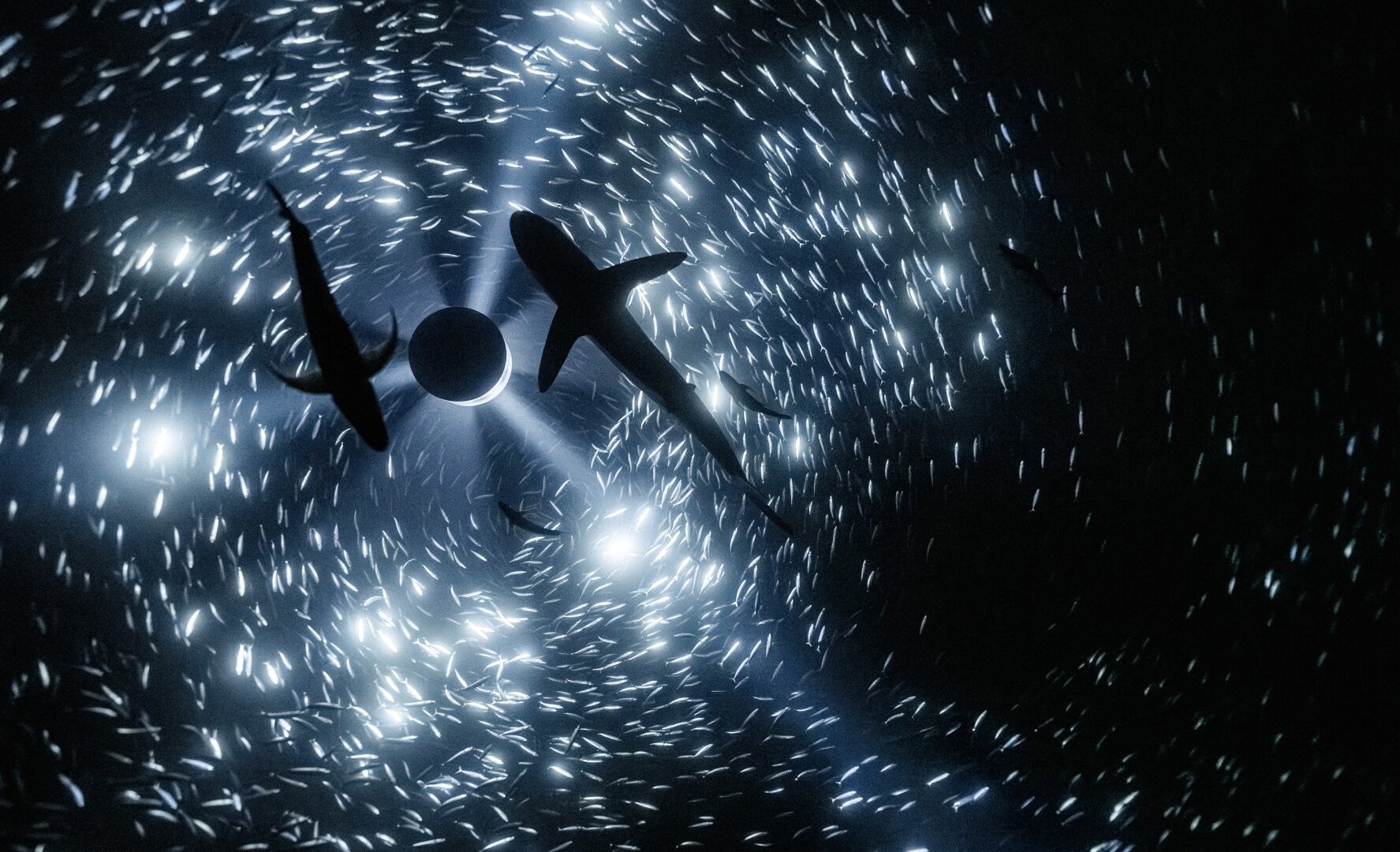
Julian Charriere, Midnight Zone, 2024, Copyright TheArtist, VG Bild Kunst, Bonn, Germany